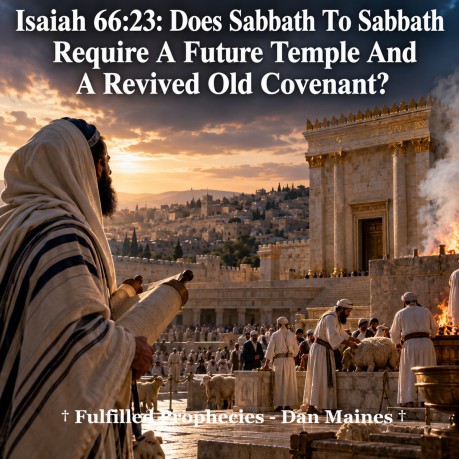
Isaiah 66:23: Does Sabbath To
Sabbath Require A Future Temple And A Revived Old Covenant? Introduction Isaiah 66:22-23 Colossians 2:16-17 Hebrews 8:13 Hebrews 7:12 Hebrews 10:11-14 John 4:21-24 Hebrews 12:22-24 Revelation 21:1-3 Revelation 21:22-24 Historical References How It Applies To Us Today Q & A Appendix Q: If Sabbath is literal in Isaiah 66:23,
wouldn't the new moon also have to be literal? Q: Does Isaiah 66 require a rebuilt temple? Q: Will Old Covenant sacrifices return? Q: Where do believers worship God now? Q: What does "all flesh" worshipping
God communicate? Q: Are believers still waiting to come to New
Jerusalem? Q: What then is the main point of Isaiah
66:23? † This is the fulfilled perspective we proclaim at
Fulfilled Prophecies † Source Index
By Dan Maines
† Isaiah
66:23 is often used to argue that Sabbath observance will return in a
future new heavens and new earth. Because Isaiah says worship will
occur "from sabbath to sabbath," some futurists conclude
that the Old Covenant Sabbath, a rebuilt temple, and even sacrifices
must exist again.
† But that interpretation
creates a serious covenant problem. The New Testament teaches that
the Old Covenant became obsolete, its priesthood changed, its
sacrifices were fulfilled in Christ, and God's dwelling place is now
His people (Hebrews 8:13; Hebrews 10:10-14; 1 Corinthians 3:16).
†
Isaiah described New Covenant realities through language his original
audience understood. Sabbath, new moon, Jerusalem, priests,
sacrifices, and temple language belonged to Israel's covenant world.
The prophetic imagery doesn't require the literal restoration of that
covenant system.
† Isaiah 66 itself points
beyond exclusive worship at an earthly temple. God declares that
heaven is His throne and earth His footstool, then asks what kind of
house Israel could build for Him (Isaiah 66:1-2).
†
The question isn't whether Isaiah used Sabbath language. He clearly
did. The question is whether the New Testament teaches that the Old
Covenant Sabbath and temple system would someday be restored after
Christ fulfilled them.
"For just as the new
heavens and the new earth, Which I make, will endure before Me,"
declares the Lord, "So will your descendants and your name
endure. And it shall be from new moon to new moon And from Sabbath to
Sabbath, All mankind will come to bow down before Me," says the
Lord.
† Notice that Isaiah didn't mention
only Sabbaths. He also said "from one new moon to another."
If the Sabbath must be restored literally because it's mentioned
here, consistency would require the restoration of Israel's new moon
observances as well.
† Paul placed new moons
and Sabbaths together when warning believers against being judged
regarding these Old Covenant observances. He called them a shadow,
while the substance belongs to Christ (Colossians 2:16-17).
†
Isaiah's emphasis is continual and universal worship. "All
flesh" coming before God presents worship extending beyond Old
Covenant Israel to the nations, something Isaiah repeatedly
anticipated (Isaiah 56:6-8; Isaiah 60:1-3).
†
The new heavens and new earth aren't presented as a return to Moses.
They're the promised New Covenant world in which God's people remain
before Him and worship isn't restricted to the former covenant order.
Therefore, no one is to
act as your judge in regard to food and drink, or in respect to a
festival or a new moon, or a Sabbath day- things which are only a
shadow of what is to come; but the substance belongs to Christ.
†
Paul gives us an inspired New Covenant explanation of the very
categories Isaiah used. Feast days, new moons, and Sabbaths belonged
to the shadow system pointing toward Christ.
†
Paul didn't tell believers that these shadows would disappear
temporarily and then return in a future new heavens and new earth. He
directed believers away from the shadows and toward Christ, who is
their substance.
† Restoring the Old Covenant
Sabbath as a required institution in the new creation would move
backward from substance to shadow.
† Isaiah
66:23 must therefore be understood consistently with the apostolic
explanation of new moons and Sabbaths, rather than interpreting Paul
through a literalistic reading that recreates the Old Covenant.
When He said, "A new
covenant," He has made the first obsolete. But whatever is
becoming obsolete and growing old is about to disappear.
†
Hebrews doesn't describe the Old Covenant as waiting for a future
restoration. It describes it as old, aging, and near disappearance in
the first century.
† The writer was living
during the covenant transition before Jerusalem and its temple were
destroyed in AD 70. The physical temple was still standing, but the
covenant it represented had already been made obsolete through Christ
(Hebrews 8:6-12).
† The destruction of
Jerusalem and the temple brought the visible Old Covenant order to
its final historical end. A future restoration of that covenant
system would contradict the direction of Hebrews.
†
The new heavens and new earth can't represent the resurrection of a
covenant that Scripture says became obsolete.
For when the priesthood is
changed, of necessity there takes place a change of law also.
†
A rebuilt Old Covenant temple would require more than a building. The
biblical temple system included a priesthood, sacrifices, an altar,
ceremonial regulations, and covenant laws governing worship.
†
Hebrews says the priesthood changed, and with that change came a
change of law. Jesus is our permanent High Priest, not according to
the Levitical order, but according to the order of Melchizedek
(Hebrews 7:17-24).
† Returning to a Levitical
temple system would reverse the movement from the temporary
priesthood to Christ's superior priesthood.
†
Isaiah's prophetic language can't be interpreted in a way that
overturns what Hebrews explicitly teaches about the priesthood and
the law.
Every priest stands daily
ministering and offering time after time the same sacrifices, which
can never take away sins; but He, having offered one sacrifice for
sins for all time, sat down at the right hand of God, waiting from
that time onward until His enemies are made a footstool for His feet.
For by one offering He has perfected for all time those who are
sanctified.
† The contrast couldn't be
stronger. Old Covenant priests repeatedly offered sacrifices, but
Christ offered one sacrifice for sins and sat down.
†
A future temple with restored animal sacrifices would have no
redemptive purpose. Christ's sacrifice doesn't need supplementation,
repetition, or memorial animal offerings.
†
Hebrews consistently moves from the temporary to the permanent, from
repeated sacrifices to Christ's finished sacrifice, and from the
earthly system to the heavenly reality (Hebrews 9:11-12; Hebrews
10:19-22).
† The new creation doesn't move
God's people backward to animal blood, Levitical priests, and an
earthly sanctuary. It brings God's people into the completed reality
those things anticipated.
Jesus said to her, "Believe
Me, woman, that a time is coming when you will worship the Father
neither on this mountain nor in Jerusalem. You Samaritans worship
what you do not know; we worship what we do know, because salvation
is from the Jews. But a time is coming, and even now has arrived,
when the true worshipers will worship the Father in spirit and truth;
for such people the Father seeks to be His worshipers. God is spirit,
and those who worship Him must worship in spirit and truth."
†
Jesus directly addressed the location of worship. He didn't point
toward a future age when worship would again center on a temple in
Jerusalem.
† He announced the opposite. The
hour was coming when worship wouldn't be centered on Jerusalem or
Mount Gerizim.
† This is crucial for Isaiah
66:23. Isaiah pictured "all flesh" coming to worship before
God, while Jesus revealed the New Covenant reality behind that
prophetic picture. True worship isn't geographically centered on an
earthly temple.
† The worldwide worship
Isaiah anticipated is fulfilled in people worshipping the Father in
spirit and truth wherever they are.
But you have come to Mount
Zion and to the city of the living God, the heavenly Jerusalem, and
to myriads of angels, to the general assembly and church of the
firstborn who are enrolled in heaven, and to God, the Judge of all,
and to the spirits of the righteous made perfect, and to Jesus, the
mediator of a new covenant, and to the sprinkled blood, which speaks
better than the blood of Abel.
† The writer
didn't tell believers they were waiting for a future earthly
Jerusalem to become the center of worship. He said they had already
come to Mount Zion and the heavenly Jerusalem.
†
This Jerusalem belongs to Jesus, the mediator of the New Covenant.
The movement is from earthly types to heavenly realities, not from
heavenly realities back to earthly types.
†
Isaiah's new creation promises find their covenant fulfillment in
this New Covenant order where God's people have access to Him through
Christ.
† Rebuilding an Old Covenant center
of worship would miss the greater Jerusalem to which believers have
already come.
Then I saw a new heaven
and a new earth; for the first heaven and the first earth passed
away, and there is no longer any sea. And I saw the holy city, new
Jerusalem, coming down out of heaven from God, prepared as a bride
adorned for her husband. And I heard a loud voice from the throne,
saying, Behold, the tabernacle of God is among the people, and He
will dwell among them, and they shall be His people, and God Himself
will be among them,
† John's new heaven and
new earth imagery draws directly from Isaiah's prophetic language,
but John identifies the holy city as New Jerusalem and describes her
as a bride.
† The dwelling place of God isn't
presented as a rebuilt stone temple. God dwells with His people.
†
The bride imagery confirms that this is covenantal language. The New
Jerusalem represents God's redeemed covenant people in union with
Christ (Revelation 21:9-10).
† Isaiah's
promise reaches its goal not in the reconstruction of the old order,
but in God's presence with His people under the New Covenant.
I saw no temple in it,
for the Lord God the Almighty and the Lamb are its temple. And the
city has no need of the sun or of the moon to shine on it, for the
glory of God has illuminated it, and its lamp is the Lamb. The
nations will walk by its light, and the kings of the earth will bring
their glory into it.
† This directly answers
the claim that Isaiah's new heavens and new earth require a rebuilt
temple. When John describes New Jerusalem, he specifically says, "I
saw no temple therein."
† There couldn't
be a clearer contrast. The old Jerusalem had a physical temple. New
Jerusalem doesn't need one because God and the Lamb are its temple.
†
Isaiah 66:23 therefore can't be used to establish a future rebuilt
temple when Revelation's new creation vision explicitly declares that
there is no temple in the city.
† The nations
walking in its light also corresponds beautifully with Isaiah's
vision of "all flesh" worshipping before God (Isaiah
66:23).
†
Josephus described the destruction of Jerusalem and its temple in AD
70 in The Wars of the Jews. His account records the catastrophic end
of the temple-centered Jewish order that had dominated Jerusalem.
†
Eusebius later connected Jerusalem's devastation with Jesus' warnings
concerning the city and recorded the tradition that believers
departed Jerusalem before the final catastrophe in Ecclesiastical
History.
† These historical witnesses don't
establish doctrine, Scripture does. They do confirm the historical
setting in which Jerusalem and its temple system came to their
devastating end.
† Nothing in the New
Testament tells believers to expect that destroyed Old Covenant
system to be rebuilt and reinstituted as God's future covenant order.
†
We don't need to travel to Jerusalem, worship in a rebuilt temple,
observe new moons, or return to the Old Covenant Sabbath system to
worship God.
† Our access to God isn't
through a building, Levitical priesthood, animal sacrifice, calendar,
or geographical location. Our access is through Jesus Christ
(Ephesians 2:18).
† Isaiah's "from one
new moon to another, and from one sabbath to another" points to
the continuing worship of God in the New Covenant creation, not the
resurrection of the covenant that Christ fulfilled.
†
We live in the reality to which the shadows pointed. Christ is our
High Priest, His sacrifice is complete, His people are His dwelling
place, and New Jerusalem is the covenant city of the living God (1
Corinthians 3:16; Hebrews 12:22-24).
†
Isaiah's prophecy isn't telling us to look forward to another temple.
Revelation tells us where the prophecy leads, "I saw no temple
therein." God and the Lamb are its temple.
†
The new heavens and new earth aren't a return to Moses. They're the
New Covenant reality established through Christ.
Q: Does
Isaiah 66:23 teach that Christians will observe the Old Covenant
Sabbath forever?
A: No. Isaiah uses both new
moon and Sabbath language to describe worship in the new creation.
Paul identifies new moons and Sabbaths as shadows whose substance
belongs to Christ (Colossians 2:16-17).
A:
Yes, that's the consistency problem with that interpretation. Isaiah
places them together, and Paul also places feast days, new moons, and
Sabbaths together as shadows pointing toward Christ (Colossians
2:16-17).
A:
No. Revelation's description of the New Jerusalem explicitly says
there is no temple in it because God and the Lamb are its temple
(Revelation 21:22).
A:
Scripture gives no need for their return. Christ offered one
sacrifice for sins and perfected His people through His completed
offering (Hebrews 10:11-14).
A:
Jesus said true worshippers worship the Father in spirit and truth,
rather than worship being centered on Jerusalem or another sacred
geographical location (John 4:21-24).
A: It communicates the
universal reach of New Covenant worship beyond national Israel. God's
worshippers are gathered from the nations and worship Him through
Christ (Isaiah 66:23; Revelation 21:24).
A: Hebrews told first-century
believers that they had come to Mount Zion, the city of the living
God, the heavenly Jerusalem, through Jesus the mediator of the New
Covenant (Hebrews 12:22-24).
A: The point isn't the restoration of
Old Covenant shadows. It's the enduring worship of God in His
promised new creation, where worship extends to all flesh and finds
its reality in Christ.
© Fulfilled Prophecies - Dan
Maines.
† Isaiah
66:22-23; Colossians 2:16-17; Hebrews 8:13; Hebrews 7:12; Hebrews
10:11-14; John 4:21-24; Hebrews 12:22-24; Revelation 21:1-3;
Revelation 21:22-24
† Josephus, The Wars of
the Jews; Eusebius, Ecclesiastical History
Links