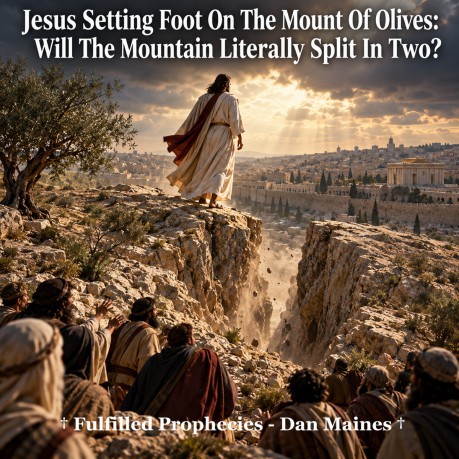
Jesus Setting Foot On The
Mount Of Olives: Will The Mountain Literally Split In Two? Introduction Zechariah 14:1-2 Zechariah 14:3-5 Micah 1:3-4 Acts 1:9-12 Matthew 24:30, 34 Luke 21:20-22 Zechariah 14:8-9 Hebrews 12:22-24 Ezekiel's Earlier Vision Of God's Glory On The Mount Of
Olives Ezekiel 11:22-23 Historical Connection Historical References How It Applies To Us Today Q & A Appendix Q: Doesn't Acts 1 prove Jesus must return to the
Mount of Olives? Q: What does the splitting of the Mount of Olives
represent? Q: Did Jesus connect Jerusalem's destruction with
fulfilled prophecy? Q: When did Jesus say His cloud-coming would
occur? Q: Should Christians today be waiting for Jesus
to physically split the Mount of Olives? † This is the fulfilled perspective we proclaim at
Fulfilled Prophecies † Source Index
By Dan Maines
† One of the
most common arguments for a future physical Second Coming is
Zechariah 14:4. Many are taught that Jesus must someday physically
descend from heaven, place His literal feet upon the Mount of Olives,
and cause the mountain to split in two.
† The
problem isn't what Zechariah says, but the assumption that prophetic
language must be interpreted as a literal description of a future
geological event. The Old Testament repeatedly describes God's
judgments with language about His coming, His feet, mountains
melting, valleys splitting, heavens shaking, and the earth trembling,
without requiring God to physically stand on the ground (Micah 1:3-4;
Psalm 18:7-15; Isaiah 64:1-3).
† Zechariah 14
must first be interpreted in its own prophetic context. Jerusalem is
under judgment, the nations surround the city, the Lord comes against
His enemies, an escape is provided, and the chapter uses the familiar
language of Old Testament judgment and deliverance.
†
Acts 1 is also important, but it never says Jesus will return to the
Mount of Olives and physically place His feet upon it. The angels
said He would come in the same manner as the disciples had seen Him
go into heaven. We shouldn't add words to the passage that aren't
there.
Behold, a day is coming for
the Lord when the spoils taken from you will be divided among you.
For I will gather all the nations against Jerusalem to battle, and
the city will be taken, the houses plundered, the women [ravished],
and half of the city exiled, but the rest of the people will not be
eliminated from the city.
† The setting is
Jerusalem under judgment. Zechariah doesn't begin with a peaceful
future world. He begins with Jerusalem surrounded, invaded, and
judged.
† Jesus described the same basic
setting when He warned His own generation that Jerusalem would be
surrounded by armies and that its desolation was near (Luke
21:20-22).
† Jesus specifically called those
events days of vengeance in which all things written would be
fulfilled. That statement gives us a powerful inspired framework for
understanding Old Testament judgment prophecies concerning Jerusalem
(Luke 21:22).
† Jerusalem was surrounded and
destroyed by Roman forces in AD 70. This provides a first-century
historical setting that shouldn't be ignored when interpreting
Zechariah's prophecy.
Then the Lord will go forth
and fight against those nations, as when He fights on a day of
battle. On that day His feet will stand on the Mount of Olives, which
is in front of Jerusalem on the east; and the Mount of Olives will be
split in its middle from east to west forming a very large valley.
Half of the mountain will move toward the north, and the other half
toward the south. And you will flee by the valley of My mountains,
for the valley of the mountains will reach to Azel; yes, you will
flee just as you fled from the earthquake in the days of Uzziah king
of Judah. Then the Lord, my God, will come, and all the holy ones
with Him!
† This is the passage most often
used to teach that Jesus must physically stand on the Mount of Olives
in our future. Yet Zechariah is speaking in the prophetic vocabulary
already established throughout the Old Testament.
†
God's feet standing upon a place signifies His presence, authority,
judgment, and intervention. Scripture doesn't require us to picture
God's physical feet whenever this language appears (Nahum 1:3-5;
Micah 1:3-4).
† Mountains splitting, melting,
shaking, and moving are common prophetic images for God's judgment
and the removal of obstacles before Him (Micah 1:3-4; Isaiah
64:1-3).
† Notice also that the splitting of
the mountain creates a way of escape. Jesus likewise warned His
first-century disciples that when they saw Jerusalem surrounded by
armies, those in Judea were to flee to the mountains (Luke
21:20-21).
† The focus isn't a future
geological spectacle for modern observers. The prophecy concerns
judgment upon Jerusalem and God's provision for His people during
that judgment.
For behold, the Lord is coming
forth from His place. He will come down and tread on the high places
of the earth. The mountains will melt under Him And the valleys will
be split, Like wax before the fire, Like water poured down a steep
place.
† Micah gives us an excellent biblical
comparison. God comes down, treads upon the high places, mountains
melt beneath Him, and valleys split.
† We
don't interpret Micah as teaching that God literally descended with
physical feet and melted geographical mountains beneath His body.
This is prophetic judgment language.
† Micah
immediately identifies the historical objects of that judgment as
Samaria and Jerusalem (Micah 1:5). The language is dramatic because
God's judgment is dramatic, not because every image must describe a
literal geological event.
† If we recognize
prophetic imagery in Micah, we should allow Zechariah to use the same
prophetic vocabulary.
And after He had said these
things, He was lifted up while they were watching, and a cloud took
Him up, out of their sight. And as they were gazing intently into the
sky while He was going, then behold, two men in white clothing stood
beside them, and they said, "Men of Galilee, why do you stand
looking into the sky? This Jesus, who has been taken up from you into
heaven, will come in the same way as you have watched Him go into
heaven." Then they returned to Jerusalem from the mountain
called Olivet, which is near Jerusalem, a Sabbath day's journey away.
† Notice carefully what the angels actually
said. Jesus would come in like manner as the disciples saw Him go.
They didn't say He would return to that exact geographical spot,
touch the mountain with physical feet, or split the Mount of Olives
in half.
† The Mount of Olives is mentioned
after the promise because that's where the disciples were when Jesus
ascended. Turning the location of the ascension into a specific
prediction about the geographical location of His coming adds
something the angels didn't say.
† The cloud
is significant. Throughout Scripture, clouds are associated with
God's presence and judgment (Psalm 18:9-12; Isaiah 19:1; Daniel
7:13).
† Jesus Himself said the Son of Man
would come on the clouds, and He placed that coming within the
lifetime of the generation standing before Him (Matthew 24:30, 34).
And then the sign of the
Son of Man will appear in the sky, and then all the tribes of the
earth will mourn, and they will see the Son of Man coming on the
clouds of the sky with power and great glory. Truly I say to you,
this generation will not pass away until all these things take
place.
† Jesus didn't leave the timing of His
coming open-ended. After describing His coming on the clouds, He said
this generation wouldn't pass away until all these things were
accomplished.
† The cloud-coming language
connects directly with Old Testament descriptions of divine judgment.
Isaiah described the LORD as riding on a swift cloud when announcing
judgment against Egypt (Isaiah 19:1).
† Jesus
wasn't teaching His disciples to expect a fulfillment thousands of
years beyond their generation. His time statement identifies the
generation that would experience the fulfillment.
†
This is why Zechariah 14 shouldn't be removed from the first-century
judgment context and turned into a future event simply because the
prophecy uses vivid language about God's feet and a splitting
mountain.
But when you see Jerusalem
surrounded by armies, then recognize that her desolation is near.
Then those who are in Judea must flee to the mountains, and those who
are inside the city must leave, and those who are in the country must
not enter the city; because these are days of punishment, so that all
things which have been written will be fulfilled.
†
Jesus gave His disciples an observable sign. When they saw Jerusalem
surrounded by armies, they were to understand that its desolation had
drawn near.
† He then told those living in
Judea to flee. This is striking when compared with Zechariah 14,
where judgment comes upon Jerusalem and a way of escape is
described.
† Most importantly, Jesus said
these were days of vengeance so that all things written would be
fulfilled. Zechariah was part of what had been written.
†
The burden of proof therefore falls upon anyone who removes Zechariah
14 from the fulfillment framework Jesus gave and places it thousands
of years into the future.
And on that day living
waters will flow out of Jerusalem, half of them toward the eastern
sea and the other half toward the western sea; it will be in summer
as well as in winter. And the Lord will be King over all the earth;
on that day the Lord will be the only one, and His name the only
one.
† The chapter itself moves from judgment
into kingdom imagery. Living waters flow from Jerusalem, and the Lord
is King.
† Jesus used living-water language
for the work of the Holy Spirit, not for a future river produced by a
geological earthquake (John 7:37-39).
† The
New Testament announces Christ's kingship as a present reality.
Christ was raised and seated at God's right hand, ruling in
fulfillment of God's promises (Acts 2:30-36; Ephesians 1:20-22).
†
Zechariah's imagery therefore fits the transition from the old
covenant world centered in earthly Jerusalem to the established
kingdom and New Covenant reality in Christ.
But you have come to Mount
Zion and to the city of the living God, the heavenly Jerusalem, and
to myriads of angels, to the general assembly and church of the
firstborn who are enrolled in heaven, and to God, the Judge of all,
and to the spirits of the righteous made perfect, and to Jesus, the
mediator of a new covenant, and to the sprinkled blood, which speaks
better than the blood of Abel.
† The New
Testament directs believers toward heavenly Zion and heavenly
Jerusalem, not toward waiting for a future earthly Jerusalem to
become the center of God's kingdom.
† The
writer didn't tell his readers that someday they would come to this
mountain and city. He said they had come to them.
†
Jesus is the mediator of the New Covenant. The fulfillment centers on
Christ and His kingdom, not the physical geography of a mountain
outside Jerusalem.
† Reading Zechariah
through the New Testament keeps our attention where the apostles
placed it, on Christ, the New Covenant, heavenly Jerusalem, and the
kingdom that can't be shaken (Hebrews 12:22-28).
Then the cherubim lifted up
their wings with the wheels beside them, and the glory of the God of
Israel hovered over them. The glory of the Lord went up from the
midst of the city and stood over the mountain which is east of the
city.
† This passage is extremely important
when interpreting Zechariah 14:4. Long before Zechariah wrote about
the LORD's feet standing on the Mount of Olives, Ezekiel described
the glory of God leaving Jerusalem and standing on the mountain east
of the city.
† Ezekiel's vision gives us an
important biblical precedent. God's glory stood on the mountain east
of Jerusalem, yet the passage isn't describing God as a physical man
whose literal feet were standing on the ground.
†
God's presence on the mountain was expressed through His glory. This
helps us understand how prophetic Scripture can describe the LORD as
standing on a mountain without requiring a future physical appearance
of Jesus standing there.
† Zechariah's
language should therefore be understood within the prophetic language
already established in Scripture. The prophets described the LORD
coming down, walking on the high places, mountains melting beneath
Him, and valleys splitting apart when describing His judgment and
divine intervention (Micah 1:3-4).
† Jesus
did physically stand on the Mount of Olives during His earthly
ministry, and Acts records His ascension from the Mount called Olivet
(Acts 1:9-12). However, Acts doesn't say that Jesus standing there
fulfilled Zechariah 14:4, nor does it say that He must physically
return to that exact location and split the mountain.
†
We shouldn't add something to Acts 1 that the passage itself doesn't
say. The angels promised that Jesus would come in the same manner as
the disciples had watched Him go into heaven, but they didn't say
that He would return to the same geographical location.
†
The stronger biblical connection is Ezekiel's vision. God's glory
departed from Jerusalem and stood on the mountain east of the city.
Zechariah later described the LORD's feet standing on the Mount of
Olives during Jerusalem's judgment. These passages share the
prophetic imagery of God's presence, judgment, and departure from
Jerusalem.
†
Eusebius specifically connected Ezekiel's vision with the Mount of
Olives. He understood the glory of the LORD as departing from
Jerusalem and moving to the Mount of Olives.
†
Josephus provides another important historical connection. When Titus
and the Roman armies approached Jerusalem in AD 70, Josephus records
that the Roman Tenth Legion came through Jericho and camped on the
Mount of Olives, east of Jerusalem across the Kidron Valley.
†
This doesn't mean that the Roman army itself was the LORD standing on
the Mount of Olives. It does show that the Mount of Olives was
directly involved in the historical events surrounding God's judgment
upon Jerusalem in AD 70.
† We don't need to
claim that a visible Glory Cloud remained on the Mount of Olives for
exactly three and a half years because the available historical
evidence doesn't establish that clearly enough to state it as fact.
†
We also don't need to claim that a Roman road literally split the
Mount of Olives or that modern aerial photographs prove Zechariah
14:4 was physically fulfilled. The evidence isn't strong enough to
make those claims.
† The biblical evidence is
stronger without those uncertain arguments. Ezekiel gives us the
prophetic background, Zechariah uses similar imagery concerning
Jerusalem's judgment, Jesus placed Jerusalem's judgment within His
generation, and the historical record confirms that the Mount of
Olives was directly involved in the events surrounding Jerusalem's
destruction in AD 70.
†
Josephus, writing about the Jewish-Roman War, records the terrible
siege, famine, warfare, destruction, and fall of Jerusalem in AD 70.
His account demonstrates how completely Jerusalem experienced the
kind of covenant judgment Jesus had warned was coming upon that
generation.
† Eusebius later reported that
believers in Jerusalem were instructed to leave the city before the
war and went to Pella. Whatever questions remain about the precise
details and chronology of that tradition, it reflects an early
Christian understanding that believers escaped Jerusalem before its
destruction.
† These historical witnesses
don't prove the interpretation by themselves. Scripture establishes
the framework, while the historical record shows that Jerusalem
experienced the catastrophic judgment and flight that Jesus had
foretold.
†
We don't need to watch the Mount of Olives waiting for Jesus to
physically place His feet upon it and split it into two pieces.
†
We should interpret prophetic language by comparing Scripture with
Scripture. When the prophets describe God coming down, mountains
melting, valleys splitting, clouds carrying Him, and the earth
shaking, we shouldn't automatically force those images into wooden
literalism.
† Jesus gave the first-century
disciples the timing and signs they needed. Jerusalem would be
surrounded, they were to flee, the days of vengeance would arrive,
and all things written concerning that judgment would be fulfilled
(Luke 21:20-22).
† Acts 1 promises that
Christ would come as He had gone, but it doesn't say that He would
physically return to the Mount of Olives, put His feet on the ground,
and split the mountain.
† Zechariah 14 uses
the language of the prophets to describe God's judgment, deliverance,
kingship, and covenantal transformation. We shouldn't add a future
physical scenario that the New Testament doesn't require.
†
Our hope isn't centered upon waiting for a mountain in Israel to
split. Our hope is centered upon Jesus Christ, His accomplished work,
His established kingdom, His New Covenant, and the heavenly Jerusalem
to which God's people have come.
Q:
Doesn't Zechariah 14:4 plainly say His feet will stand on the Mount
of Olives?
A: Yes, that's exactly what the
prophecy says. The question is whether prophetic references to God's
feet must always describe literal physical feet. Micah uses the same
type of language when God comes down, treads upon the high places,
melts mountains, and splits valleys (Micah 1:3-4). Scripture itself
teaches us how prophetic judgment language functions.
A: Acts 1:9-12 says Jesus
ascended from the Mount of Olives and would come in like manner. It
doesn't say He would return to that exact location or physically
place His feet upon that mountain.
A: Within Zechariah's prophecy, the
splitting creates a way of escape during Jerusalem's judgment.
Mountains moving and valleys splitting are established prophetic
images connected with God's intervention and judgment (Micah 1:3-4;
Isaiah 64:1-3).
A: Yes. Jesus said that
when Jerusalem was surrounded by armies, its desolation was near, His
followers were to flee, and these were days of vengeance in which all
things written would be fulfilled (Luke 21:20-22).
A: Jesus described the Son of Man coming
on the clouds with power and great glory and then said, This
generation shall not pass away, till all these things be accomplished
(Matthew 24:30, 34).
A:
From the fulfilled perspective, no. Zechariah's prophecy belongs
within the biblical language of Jerusalem's judgment, deliverance,
and the establishment of Christ's kingdom. The New Testament directs
believers to Christ, the New Covenant, and heavenly Jerusalem
(Hebrews 12:22-24).
© Fulfilled Prophecies - Dan
Maines.
† Zechariah
14:1-5, 8-9; Micah 1:3-4; Ezekiel 11:22-23; Acts 1:9-12; Matthew
24:30, 34; Luke 21:20-22; Hebrews 12:22-24
†
Josephus, The Wars of the Jews; Eusebius, Ecclesiastical History
Links