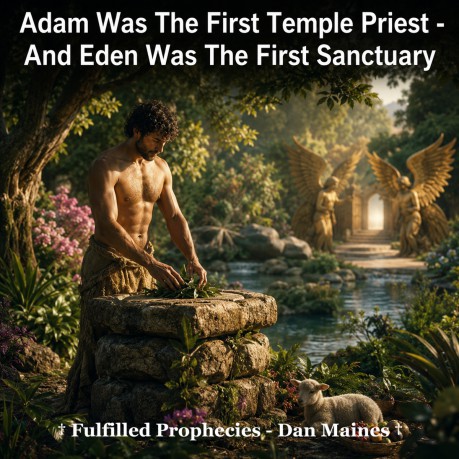
Adam Was The First Temple
Priest - And Eden Was The First Sanctuary Introduction Genesis 2:8-10 Genesis 2:11-12 Genesis 2:15 Genesis 3:8 Genesis 3:23-24 Exodus 25:8-9 1 Kings 6:29-30 John 2:19-21 Ephesians 2:19-22 Revelation 21:2-3 Revelation 21:22 Revelation 22:1-2 Historical References How It Applies To Us Today Q & A Appendix † This is the fulfilled perspective we proclaim at
Fulfilled Prophecies †
By Dan Maines
† The Temple
story doesn't begin with Solomon. It doesn't even begin with Moses
and the Tabernacle. The pattern begins in Genesis, where God planted
a garden, placed His image-bearer within it, gave him sacred work,
and walked in His presence.
† Eden contains
remarkable features that later appear in Israel's Tabernacle and
Temple: God's presence, an eastward entrance, cherubim guarding
sacred space, precious materials, a life-giving river, trees, and a
man commissioned to serve and guard the place where God dwelled.
†
This means Adam wasn't merely the first farmer. His commission used
language later associated with priestly service. Eden wasn't merely
humanity's first home. It functioned as the Bible's first
sanctuary.
† Once this pattern is recognized,
a magnificent biblical movement comes into view: Eden to Tabernacle,
Tabernacle to Temple, Temple to Christ, Christ to His people, and
finally the New Creation where God's dwelling is with humanity.
†
The wow moment is simple but enormous: the Temple story may begin on
the opening pages of the Bible, and the entire story moves toward God
dwelling with His people without a physical Temple standing between
them.
The Lord God planted a garden
toward the east, in Eden; and there He placed the man whom He had
formed. Out of the ground the Lord God caused every tree to grow that
is pleasing to the sight and good for food; the tree of life was also
in the midst of the garden, and the tree of the knowledge of good and
evil. Now a river flowed out of Eden to water the garden; and from
there it divided and became four rivers.
†
Eden was a place specially prepared by God, and Adam was placed there
by God. This wasn't simply a random piece of agricultural land. It
was the place where humanity lived in fellowship with the Creator
(Genesis 3:8).
† A river flowed out from Eden
and carried life outward. Later prophetic Temple imagery also
presents water flowing from God's sacred dwelling and bringing life
wherever it goes (Ezekiel 47:1-12).
†
Revelation completes the pattern with the river of the water of life
flowing from the throne of God and of the Lamb, with the tree of life
beside it (Revelation 22:1-2). Genesis begins with garden, river,
tree, and God's presence, and Revelation ends with those themes
restored in their completed form.
The name of the first is
Pishon; it flows around the whole land of Havilah, where there is
gold. The gold of that land is good; the bdellium and the onyx stone
are there as well.
† Genesis deliberately
mentions gold and precious material in connection with the region
surrounding Eden. Those same kinds of materials become prominent when
Scripture describes sacred places associated with God's dwelling.
†
The Tabernacle was filled with gold, and onyx stones were placed on
the priestly garments (Exodus 25:10-22; 28:9-12). Solomon's Temple
was likewise characterized by extensive use of gold (1 Kings
6:20-22).
† Revelation's New Jerusalem again
uses gold and precious stones when describing God's completed
dwelling with His people (Revelation 21:18-21). The Bible begins and
ends with God's dwelling associated with garden imagery and precious
materials.
Then the Lord God took the man
and put him in the Garden of Eden to cultivate it and tend it.
†
This verse is one of the strongest connections between Eden and the
later sanctuary. Adam wasn't merely told to enjoy Eden. He was given
responsibility within sacred space.
† The
Hebrew verbs translated dress and keep are 'abad and shamar. These
words can describe ordinary work and guarding, but significantly,
they appear together in connection with the Levites' responsibilities
surrounding the sanctuary (Numbers 3:7-8; 8:25-26; 18:5-6).
†
Adam's assignment therefore anticipates priestly responsibility. He
was to serve within the garden and guard what God had entrusted to
him.
† This also makes Adam's failure more
significant. When the serpent entered the sacred place, Adam failed
to guard the sanctuary entrusted to him (Genesis 3:1-6). The first
guardian of sacred space failed his commission.
Now they heard the sound of the
Lord God walking in the garden in the cool of the day, and the man
and his wife hid themselves from the presence of the Lord God among
the trees of the garden.
† The defining glory
of Eden wasn't its vegetation, gold, rivers, or beauty. Its greatest
glory was God's presence.
† The same theme
governs the Tabernacle. God instructed Israel to construct a
sanctuary so He could dwell among them (Exodus 25:8).
†
The same theme governed the Temple, and it ultimately reaches its
fulfillment in Christ and the New Covenant people of God (John 1:14;
Ephesians 2:21-22).
† From Genesis to
Revelation, the central sanctuary question isn't ultimately, Where is
the building? The deeper question is, Where does God dwell with
humanity?
therefore the Lord God sent
him out of the Garden of Eden, to cultivate the ground from which he
was taken. So He drove the man out; and at the east of the Garden of
Eden He stationed the cherubim and the flaming sword which turned
every direction to guard the way to the tree of life.
†
After Adam's sin, access to the garden was restricted, and cherubim
guarded the way into sacred space.
† Notice
that the guarded entrance is associated with the east. Later, the
Tabernacle's entrance was on the east side, and the Temple likewise
developed this eastward orientation (Exodus 27:13-16; Ezekiel
40:6).
† Cherubim also became prominent
symbols within Israel's sanctuary. Cherubim overshadowed the mercy
seat above the ark, and images of cherubim appeared throughout the
Temple (Exodus 25:18-22; 1 Kings 6:23-29).
†
Eden's cherubim weren't an isolated detail. They introduced imagery
that reappeared when God established later sacred spaces among His
covenant people.
Have them construct a
sanctuary for Me, so that I may dwell among them. According to all
that I am going to show you as the pattern of the tabernacle and the
pattern of all its furniture, so you shall construct it.
†
The purpose of the Tabernacle is stated plainly: God intended to
dwell among His people.
† That takes us
directly back to Eden. The sanctuary wasn't introducing an entirely
new biblical idea. It was developing the ancient theme of God's
presence dwelling among humanity.
† Eden had
sacred space, God's presence, guarded access, cherubim, precious
materials, and a commissioned servant. The Tabernacle gathered these
themes into Israel's covenant worship system.
Then he carved all the
surrounding walls of the house with engravings of cherubim, palm
trees, and open flowers, for the inner and outer sanctuaries. And he
overlaid the floor of the house with gold, for the inner and outer
sanctuaries.
† Solomon's Temple visually
recalled a garden. Cherubim, palm trees, flowers, and gold filled
God's house.
† A worshiper entering this
sanctuary encountered imagery that echoed the garden sanctuary of
Genesis.
† The Temple wasn't Eden restored in
its final sense. It was another stage in the biblical sanctuary
story, pointing beyond itself toward something greater.
Jesus answered them, "Destroy
this temple, and in three days I will raise it up." The Jews
then said, "It took forty-six years to build this temple, and
yet You will raise it up in three days?" But He was speaking
about the temple of His body.
† Here the
sanctuary story takes its decisive turn. Jesus identified His body as
the Temple.
† God's presence was no longer
centered ultimately in a structure made with human hands. God had
come among His people in Christ (John 1:14; Colossians 2:9).
†
Jesus is where humanity meets God. The Temple wasn't the destination
of the biblical story. Christ was.
† This is
why destroying Jesus and raising Him again was described in Temple
language. The reality had arrived to which the earlier sanctuary
patterns were pointing.
So then you are no longer
strangers and foreigners, but you are fellow citizens with the
saints, and are of God's household, having been built on the
foundation of the apostles and prophets, Christ Jesus Himself being
the cornerstone, in whom the whole building, being fitted together,
is growing into a holy temple in the Lord, in whom you also are being
built together into a dwelling of God in the Spirit.
†
The movement continues from Christ as Temple to His people as God's
holy Temple.
† Paul didn't tell believers
that they were waiting for another physical sanctuary to become the
center of God's redemptive program. He told them they were already
being built together into God's dwelling in the Spirit.
†
The dwelling place of God had moved from shadows and structures to
Christ and His covenant people.
† Adam was
placed in God's garden sanctuary. Israel worshiped at God's
Tabernacle and Temple. Christ embodied God's presence. Now those who
are in Christ constitute God's spiritual dwelling.
And I saw the holy city,
new Jerusalem, coming down out of heaven from God, prepared as a
bride adorned for her husband. And I heard a loud voice from the
throne, saying, Behold, the tabernacle of God is among the people,
and He will dwell among them, and they shall be His people, and God
Himself will be among them,
† Revelation
brings the sanctuary theme to its covenantal goal. The direction is
important. The city comes down from God, and the announcement is that
God's Tabernacle is with humanity.
† The
biblical story isn't primarily humanity escaping creation to reach
God's dwelling. It's the story of God establishing His dwelling with
His redeemed people.
† What was experienced
in Eden, pictured in the Tabernacle, displayed in the Temple,
embodied in Christ, and established in His people reaches its
completed covenant expression in the New Jerusalem.
†
The Bible begins with God dwelling with humanity in a garden and
closes with God dwelling with His people in the New Creation.
I saw no temple in it, for
the Lord God the Almighty and the Lamb are its temple.
†
This is one of the greatest surprises in the entire Temple story. The
New Jerusalem has no physical Temple.
† Why
isn't there a Temple? Because the Temple's purpose has reached its
fulfillment. God and the Lamb are its Temple.
†
The Bible's sanctuary story therefore doesn't end with the
reconstruction of another sacred building. It ends with unrestricted
access to God through the Lamb.
† Eden had a
sanctuary. Israel had a Tabernacle. Jerusalem had a Temple. Jesus
came as the true Temple. His people became God's dwelling. The New
Jerusalem needs no separate Temple because God's presence fills the
covenant reality.
And he showed me a river
of the water of life, clear as crystal, coming from the throne of God
and of the Lamb, in the middle of its street. On either side of the
river was the tree of life, bearing twelve kinds of fruit, yielding
its fruit every month; and the leaves of the tree were for the
healing of the nations.
† Now the pattern
reaches its breathtaking conclusion. Genesis opened with a river and
the tree of life in God's garden. Revelation closes with the river of
life and the tree of life in God's completed covenant world.
†
The guarded tree of Genesis 3 is accessible again in Revelation 22.
The story has moved from lost access to restored access through
Christ (Revelation 22:14).
† This is why Eden
matters so much to understanding biblical prophecy. Genesis
established the sanctuary vocabulary that the rest of Scripture
develops.
† The Bible's Temple story wasn't
moving toward another stone building in the Middle East. It was
moving toward Christ, His people, and the restored presence of God in
the New Creation.
†
Josephus described the Jerusalem Temple as a sacred structure filled
with symbolic features and magnificent materials, including extensive
gold, showing how deeply sacred-space imagery remained embedded in
Jewish worship during the first century (Josephus, Wars 5.5).
†
Josephus also described the Temple veil as embroidered with imagery
representing the created order, demonstrating that ancient Jewish
sanctuary symbolism could connect the Temple with God's creation
itself (Josephus, Wars 5.5.4).
† Philo
described the Tabernacle and its furnishings using cosmic symbolism,
showing that ancient Jewish interpreters recognized connections
between God's sanctuary and the ordered creation (Philo, On the Life
of Moses 2.88-135).
† These historical
witnesses don't prove that Genesis explicitly calls Eden a Temple,
but they support the larger ancient Jewish understanding that
sanctuary, creation, divine presence, and sacred symbolism belonged
together.
†
We don't need to look for another physical Temple to restore access
to God. In Christ, believers have access to the Father and are
already members of God's household (Ephesians 2:18-22).
†
God's great purpose has always been fellowship with His people. Sin
disrupted that fellowship in Eden, but Christ accomplished what Adam
couldn't accomplish and brought His people into the presence of God
(Romans 5:17-19).
† We aren't waiting for God
to return to a stone sanctuary. God's people are His dwelling through
the Spirit, and Jesus Christ is the cornerstone of that living Temple
(Ephesians 2:20-22).
† The story that began
in Eden has reached its New Covenant reality. The river flows, the
tree of life stands available, the nations receive healing, and God
dwells with His people in the New Jerusalem (Revelation 21:2-3;
22:1-2).
† The Temple story begins far
earlier than many people realize. Once Eden is recognized as the
Bible's first sanctuary pattern, the entire storyline becomes
clearer: Eden to Tabernacle, Tabernacle to Temple, Temple to Christ,
Christ to His people, and His people dwelling with God in the New
Creation.
Q: Does
Genesis actually call Eden a Temple?
A: No.
Genesis doesn't use the later word Temple for Eden. The connection
comes from the accumulation of sanctuary features: God's presence,
cherubim, an eastern entrance, precious materials, sacred service and
guarding, the tree of life, and a life-giving river (Genesis 2:8-15;
3:8, 23-24). The claim is that Eden functions as the Bible's first
sanctuary pattern, not that Genesis directly labels it a Temple.
Q:
Why call Adam a priest if Genesis doesn't use the word priest?
A:
Because Adam was placed in sacred space to dress and keep it, and the
Hebrew verbs behind those words are later used together for Levitical
service and guarding associated with God's sanctuary (Genesis 2:15;
Numbers 3:7-8; 8:25-26). Adam's commission therefore has a strong
priestly pattern.
Q: Why were cherubim placed
at Eden?
A: They guarded access to the tree of
life after humanity was expelled. Cherubim later appeared prominently
in the Tabernacle and Temple, especially around the place
representing God's throne and presence (Genesis 3:24; Exodus
25:18-22; 1 Kings 6:23-29).
Q: Does the New
Covenant require another physical Temple?
A:
No. Jesus identified His body as the Temple, believers are God's holy
Temple and dwelling in the Spirit, and the New Jerusalem explicitly
has no separate Temple because God and the Lamb are its Temple (John
2:19-21; Ephesians 2:19-22; Revelation 21:22).
Q:
What is the biggest wow moment in this study?
A:
The Bible's sanctuary story doesn't begin with Moses and doesn't end
with another building. It begins with God's presence among humanity
in Eden and reaches its goal in God's presence with His people
through Christ in the New Creation (Genesis 3:8; Revelation 21:2-3,
22; 22:1-2).
© Fulfilled Prophecies - Dan
Maines.
Source Index
†
Genesis 2:8-10; Genesis 2:11-12; Genesis 2:15; Genesis 3:8; Genesis
3:23-24; Exodus 25:8-9; 1 Kings 6:29-30; John 2:19-21; Ephesians
2:19-22; Revelation 21:2-3; Revelation 21:22; Revelation 22:1-2
†
Josephus, Wars 5.5; Josephus, Wars 5.5.4; Philo, On the Life of Moses
2.88-135
Links