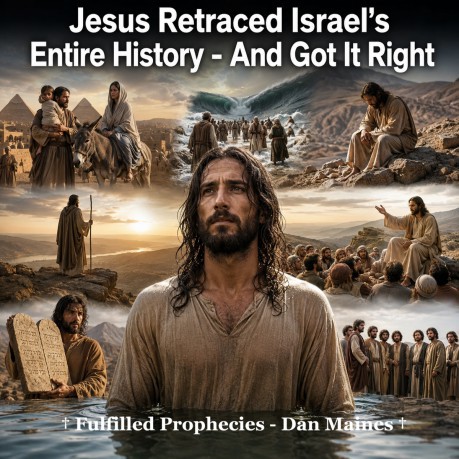
Jesus Retraced Israel's
Entire History - And Got It Right Introduction Hosea 11:1 Matthew 2:14-15 1 Corinthians 10:1-2 Matthew 3:16-17 Deuteronomy 8:2-3 Matthew 4:1-4 Exodus 19:3 Matthew 5:1-2 Matthew 10:1-2 Matthew 19:28 Isaiah 49:3 Galatians 3:16 2 Corinthians 1:20 Historical References How It Applies To Us Today Q & A Appendix Q: Why did Jesus spend forty days in the
wilderness? Q: Why did Jesus choose twelve apostles instead
of another number? Q: Does this mean Jesus replaced Israel? Q: Are God's promises still waiting for
fulfillment through modern national Israel? Q: What's the central message of these
parallels? † This is the fulfilled perspective we proclaim at
Fulfilled Prophecies †
By Dan Maines
† Jesus
didn't simply arrive in Israel and announce that He was Israel's
Messiah. The Gospel writers present Him deliberately retracing
Israel's story, but where Israel failed, Jesus remained faithful.
†
Israel was called God's son, came out of Egypt, passed through the
waters, entered the wilderness, received God's instruction at a
mountain, and was organized around twelve tribes. Jesus repeats that
pattern in His own ministry, He comes out of Egypt, passes through
baptismal waters, enters the wilderness, teaches from a mountain, and
appoints twelve disciples.
† This isn't a
collection of accidental similarities. Matthew especially arranges
the opening of Jesus' ministry so that Israel's history is being
replayed in the life of Christ. The difference is that the obedient
Son succeeds where the covenant nation repeatedly failed.
†
Jesus wasn't merely sent to Israel from the outside. He gathered
Israel's covenant calling into Himself, fulfilled its purpose, and
became the faithful Israelite through whom God's promises reached
their intended goal (Matthew 5:17; Romans 15:8; Galatians 3:16).
When Israel was a youth I loved
him, And out of Egypt I called My son.
†
Hosea is speaking historically about Israel's exodus from Egypt. God
called the covenant nation His son. Matthew later applies this same
language to Jesus, showing that Christ personally retraced the
history of God's national son (Matthew 2:14-15).
†
This establishes the pattern. Israel was God's corporate son, but
Jesus is God's faithful Son. Israel's history becomes a prophetic
pattern that reaches its goal in Christ (Exodus 4:22-23; Matthew
2:15).
† Jesus didn't merely fulfill an
isolated prediction about Egypt. He entered Israel's story and began
reliving it faithfully.
So Joseph got up and took
the Child and His mother while it was still night, and left for
Egypt. He stayed there until the death of Herod; this happened so
that what had been spoken by the Lord through the prophet would be
fulfilled: "Out of Egypt I called My Son."
†
Matthew intentionally takes Hosea's description of Israel and applies
it to Jesus. The identification is unmistakable. Israel was called
God's son, and now Jesus, the true and faithful Son, comes out of
Egypt.
† This is one of the strongest clues
for understanding the structure of Matthew's Gospel. Jesus begins
retracing Israel's national history in His own life.
†
Israel came out of Egypt under Moses. Jesus comes out of Egypt as the
One who'll accomplish what Israel's calling anticipated (Hosea 11:1;
Matthew 1:21).
For I do not want you
to be unaware, brothers and sisters, that our fathers were all under
the cloud and they all passed through the sea; and they all were
baptized into Moses in the cloud and in the sea;
†
After Israel came out of Egypt, the nation passed through the waters
of the Red Sea. Paul even describes that event as a baptism.
†
Matthew follows the same sequence with Jesus. After Jesus comes out
of Egypt, the narrative moves toward His baptism in the Jordan
(Matthew 3:13-17).
† Israel passed through
water before entering its wilderness testing. Jesus passes through
the waters of baptism immediately before entering His wilderness
testing. The sequence is remarkably precise.
After He was baptized, Jesus
came up immediately from the water; and behold, the heavens were
opened, and he saw the Spirit of God descending as a dove and
settling on Him, and behold, a voice from the heavens said, "This
is My beloved Son, with whom I am well pleased."
†
The identification of Jesus as God's Son immediately before the
wilderness temptation is crucial. Israel had been called God's son,
and now the Father publicly identifies Jesus as His beloved Son
(Hosea 11:1; Matthew 2:15).
† Israel passed
through the sea and entered the wilderness. Jesus passes through
baptismal water and immediately enters the wilderness (Matthew
4:1).
† But there's a decisive difference.
Israel repeatedly failed its testing. The Father declares His
pleasure in Jesus, and Jesus remains obedient throughout His testing.
And you shall remember all
the way which the Lord your God has led you in the wilderness these
forty years, in order to humble you, putting you to the test, to know
what was in your heart, whether you would keep His commandments or
not. And He humbled you and let you go hungry, and fed you with the
manna which you did not know, nor did your fathers know, in order to
make you understand that man shall not live on bread alone, but man
shall live on everything that comes out of the mouth of the Lord.
†
Israel spent forty years in the wilderness being tested. Jesus spends
forty days in the wilderness being tested. The numerical
correspondence strengthens the deliberate connection between Israel's
story and Christ's ministry (Numbers 14:33-34; Matthew 4:2).
†
When Satan tempts Jesus to turn stones into bread, Jesus answers
directly from this passage in Deuteronomy (Matthew 4:3-4).
†
Jesus is standing where Israel once stood. Israel experienced hunger
and repeatedly complained against God. Jesus experiences hunger and
remains faithful.
† The Son refuses to use
His power independently of the Father's will. Where Israel's heart
was exposed through testing, Jesus' perfect faithfulness is revealed
through testing.
Then Jesus was led up by the
Spirit into the wilderness to be tempted by the devil. And after He
had fasted for forty days and forty nights, He then became hungry.
And the tempter came and said to Him, "If You are the Son of
God, command that these stones become bread." But He answered
and said, "It is written: 'Man shall not live on bread alone,
but on every word that comes out of the mouth of God.'"
†
Jesus doesn't answer Satan randomly. His response comes from Israel's
wilderness story in Deuteronomy 8:3.
† Each
major response Jesus gives during the temptation comes from
Deuteronomy, the book that repeatedly looks back on Israel's
wilderness experience (Deuteronomy 6:13, 16; 8:3).
†
Israel tested God, turned toward idolatry, and complained about food.
Jesus refuses every corresponding temptation and remains completely
loyal to His Father.
† The message is
powerful. Jesus isn't repeating Israel's rebellion. He's rewriting
Israel's history through perfect covenant faithfulness.
And Moses went up to God, and
the Lord called to him from the mountain, saying, This is what you
shall say to the house of Jacob and tell the sons of Israel:
†
Israel's wilderness story led to a mountain where Moses received
God's covenant instruction for the nation.
†
Matthew again presents a striking correspondence. After Jesus'
wilderness victory and the beginning of His ministry, Jesus goes up a
mountain and begins teaching His disciples and the crowds (Matthew
5:1-2).
† Jesus isn't merely another Moses
receiving information from God. He teaches with His own authority,
repeatedly declaring what He says concerning the true meaning and
fulfillment of God's Law (Matthew 5:21-22, 27-28, 31-32).
†
The mountain setting connects Jesus' teaching ministry with Sinai
while also showing that something greater than Moses is present.
Now when Jesus saw the crowds,
He went up on the mountain; and after He sat down, His disciples came
to Him. And He opened His mouth and began to teach them, saying,
†
Matthew's language deliberately places Jesus on the mountain as the
authoritative teacher of God's people.
†
Shortly afterward Jesus makes His purpose unmistakable, He didn't
come to destroy the law or the prophets but to fulfill them (Matthew
5:17).
† Israel received Torah through Moses.
Jesus reveals its fulfillment and brings God's covenant purpose to
its intended completion.
† The Sermon on the
Mount therefore isn't disconnected moral advice. It belongs within
Matthew's larger presentation of Jesus as the One in whom Israel's
story reaches fulfillment.
Jesus summoned His twelve
disciples and gave them authority over unclean spirits, to cast them
out, and to heal every disease and every sickness. Now the names of
the twelve apostles are these: The first, Simon, who is called Peter,
and his brother Andrew; and James the son of Zebedee, and his brother
John;
† Jesus' selection of exactly twelve
apostles wasn't arbitrary. Israel had been constituted around twelve
tribes, and Jesus deliberately establishes His messianic community
around twelve representatives (Genesis 49:28; Matthew 19:28).
†
Jesus later makes the symbolism explicit by connecting the twelve
apostles with the twelve tribes of Israel (Matthew 19:28).
†
The twelve therefore signal restoration and fulfillment. Jesus is
gathering God's covenant people around Himself.
†
Israel's identity is being reorganized around allegiance to Israel's
Messiah. Jesus stands at the center of the renewed people of God.
And Jesus said to them, Truly
I say to you, that you who have followed Me, in the regeneration when
the Son of Man will sit on His glorious throne, you also shall sit
upon twelve thrones, judging the twelve tribes of Israel.
†
Jesus Himself confirms that the number twelve carries Israel
significance. Twelve apostles correspond directly to twelve tribes.
†
This makes it difficult to dismiss the earlier parallels as
coincidence. Egypt, water, wilderness, forty, mountain, covenant
teaching, and twelve representatives form a sustained pattern.
†
Jesus is gathering Israel's story into Himself and His kingdom
mission. What national Israel couldn't accomplish through repeated
covenant failure, the faithful Messiah accomplished through obedience
(Romans 5:19; Philippians 2:8).
He said to Me, "You are My
Servant, Israel, In whom I will show My glory."
†
Isaiah identifies the servant as Israel, yet the following verses
distinguish this servant from the nation because the servant's
mission is to bring Jacob back to God (Isaiah 49:5-6).
†
This creates an important biblical category, one faithful
representative can embody the calling of the larger people.
†
Jesus fulfills this servant mission. He embodies Israel's calling
faithfully and accomplishes the mission that rebellious Israel
couldn't accomplish.
† The identity of Israel
therefore reaches its concentrated fulfillment in the Messiah. Jesus
represents Israel before God and fulfills Israel's vocation through
perfect obedience.
Now the promises were spoken
to Abraham and to his seed. He does not say, "And to seeds,"
as one would in referring to many, but rather as in referring to one,
"And to your seed," that is, Christ.
†
Paul takes the promises associated with Abraham's seed and brings
them directly to Christ. The covenant story narrows toward one
representative person.
† This doesn't erase
God's previous dealings with Israel. It explains where those dealings
were always headed. Abraham, Israel, the Law, the promises, and the
prophetic hope converge in Jesus.
† Christ is
therefore more than someone who happens to fulfill predictions made
about Israel. He is the representative Seed in whom the covenant
promises reach their goal.
† Those who belong
to Christ participate in that fulfilled inheritance because their
identity is found in Him, not in ethnicity, genealogy, or possession
of the old covenant Law (Galatians 3:26-29).
For as many as the
promises of God are, in Him they are yes; therefore through Him also
is our Amen to the glory of God through us.
†
God's promises don't reach their final meaning in a modern
geopolitical nation. Paul says God's promises find their Yes in
Christ.
† Jesus came out of Egypt, passed
through water, conquered the wilderness, taught from the mountain,
gathered the twelve, fulfilled the Law, and completed the mission
entrusted to Him.
† Israel failed repeatedly,
but Jesus didn't fail. Israel broke covenant, but Jesus remained
obedient. Israel's story exposed humanity's need for a faithful
representative, and Jesus became that faithful representative.
†
Jesus was Israel's Messiah, but Matthew's presentation goes deeper.
Jesus embodied Israel's calling, retraced Israel's history, succeeded
where Israel failed, and carried God's covenant purpose into
fulfillment.
†
Josephus described first-century Jewish identity as inseparably
connected with Moses, the Law, the temple, the ancestral customs, and
Israel's national history. His writings demonstrate how deeply these
covenant institutions defined Jewish life in the generation when
Jesus and the apostles proclaimed fulfillment.
†
Josephus also recorded the catastrophic destruction of Jerusalem and
the temple in AD 70, the historical judgment that permanently ended
the old covenant temple order centered in that city (Josephus, Wars
of the Jews, Books 5-7).
† Eusebius later
described Christ and the apostolic mission as the fulfillment and
worldwide extension of God's ancient promises rather than the
restoration of the Mosaic national system (Eusebius, Ecclesiastical
History, Books 1-3).
† These historical
witnesses don't establish the doctrine, Scripture does. They help
confirm the historical setting in which the transition from the old
covenant nation centered on Jerusalem to the fulfilled kingdom in
Christ took place.
†
We don't need to return to old covenant Israel to find the promises
of God. We come to Christ, because God's promises reach their
fulfillment in Him (2 Corinthians 1:20).
†
Our standing before God isn't determined by ethnicity, national
ancestry, an earthly temple, or membership in one of Israel's
physical tribes. Our identity is found in Christ (Galatians
3:26-29).
† Jesus succeeded where Israel
failed. That means our confidence rests in His faithfulness rather
than man's ability to reproduce Israel's old covenant system.
†
We aren't waiting for Jesus to restart Israel's unfinished story.
Jesus finished the mission entrusted to Him and established the
kingdom that the prophets anticipated (Luke 24:44; John 17:4; John
19:30).
† The pattern is breathtaking when we
see it together. Israel came out of Egypt, Jesus came out of Egypt.
Israel passed through water, Jesus passed through water. Israel
entered the wilderness, Jesus entered the wilderness. Israel was
tested for forty years, Jesus was tested for forty days. Israel
received instruction at a mountain, Jesus taught from a mountain.
Israel consisted of twelve tribes, Jesus appointed twelve apostles.
†
But the greatest contrast is this, Israel repeatedly failed, Jesus
got it right.
† Jesus Retraced Israel's
Entire History - And Got It Right.
Q: Was
Jesus simply copying events from Israel's history?
A:
No. Matthew presents these events as fulfillment. Jesus' life
deliberately follows Israel's pattern because He is the faithful Son
who accomplishes what God's covenant purpose required (Hosea 11:1;
Matthew 2:15).
A: The forty days correspond to
Israel's forty-year wilderness testing. Jesus answers His temptations
from Deuteronomy, directly connecting His experience with Israel's
wilderness history (Deuteronomy 8:2-3; Matthew 4:1-4).
A: The twelve represented
the twelve tribes of Israel. Jesus explicitly connected His twelve
apostles with Israel's twelve tribes (Matthew 10:1-2; Matthew 19:28).
A:
The stronger biblical point is fulfillment. Jesus is Israel's
Messiah, Abraham's promised Seed, and the faithful representative in
whom God's covenant promises reach their Yes and Amen (Galatians
3:16; 2 Corinthians 1:20).
A:
Paul directs God's promises to Christ. The promises find their Yes in
Him, and those who belong to Christ share in the promised inheritance
(2 Corinthians 1:20; Galatians 3:26-29).
A: Israel's history pointed toward
Christ. Where Israel failed under testing, Jesus remained faithful.
He didn't abandon Israel's calling, He fulfilled its purpose in
Himself (Matthew 4:1-4; Matthew 5:17).
© Fulfilled Prophecies - Dan
Maines.
Source Index
†
Hosea 11:1; Matthew 2:14-15; 1 Corinthians 10:1-2; Matthew 3:16-17;
Deuteronomy 8:2-3; Matthew 4:1-4; Exodus 19:3; Matthew 5:1-2; Matthew
10:1-2; Matthew 19:28; Isaiah 49:3; Galatians 3:16; 2 Corinthians
1:20
† Josephus, Wars of the Jews, Books 5-7;
Eusebius, Ecclesiastical History, Books 1-3
Links