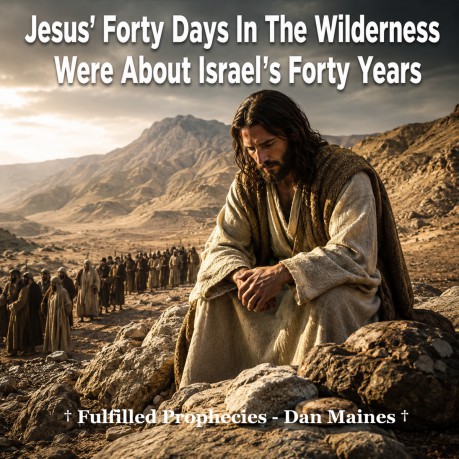
Jesus' Forty Days In The
Wilderness Were About Israel's Forty Years Introduction Matthew 3:16-17 Exodus 4:22-23 Numbers 14:32-34 Deuteronomy 8:2-3 Matthew 4:1-4 Deuteronomy 6:16 Matthew 4:5-7 Deuteronomy 6:13-15 Matthew 4:8-11 Hebrews 3:8-11 Historical References How It Applies To Us Today Q & A Appendix † This is the fulfilled perspective we proclaim at
Fulfilled Prophecies † Source Index
By Dan Maines
† Jesus'
forty days in the wilderness weren't an isolated story about
resisting temptation. Matthew deliberately places Jesus into the
pattern of Israel's history. Israel passed through the sea, entered
the wilderness, was tested, became hungry, and repeatedly failed to
trust God. Jesus passed through the waters of baptism, entered the
wilderness, was tested, became hungry, and remained faithful.
†
The connection becomes unmistakable when we notice how Jesus answered
Satan. He didn't randomly select three convenient Bible verses. Every
Scripture He used came from Deuteronomy, specifically from Moses'
explanation of Israel's wilderness testing (Deuteronomy 6:13, 16;
8:3).
† Israel spent forty years in the
wilderness because of unbelief. Jesus spent forty days in the
wilderness and succeeded where Israel failed. The forty days weren't
accidental. Jesus was retracing Israel's story as the faithful Son.
†
This is one of those places where the Old and New Testaments lock
together. Without Israel's wilderness history, Jesus' temptation
account can look like three disconnected temptations. With
Deuteronomy open beside Matthew, the pattern becomes clear.
After He was baptized, Jesus
came up immediately from the water; and behold, the heavens were
opened, and he saw the Spirit of God descending as a dove and
settling on Him, and behold, a voice from the heavens said, "This
is My beloved Son, with whom I am well pleased."
†
Matthew identifies Jesus as God's Son immediately before sending Him
into the wilderness. That sequence matters. Israel had also been
called God's son before being brought out of Egypt and into the
wilderness (Exodus 4:22-23).
† Jesus' baptism
is followed immediately by wilderness testing. Israel's deliverance
through the sea was followed by wilderness testing. Matthew is
showing us a pattern, water, sonship, wilderness, testing.
†
The Father declared Jesus to be His beloved Son before the testing
began. The wilderness would reveal the obedience of that Son, not
because Jesus needed to discover who He was, but because His
faithfulness would stand in deliberate contrast with Israel's failure
(Matthew 4:1-11).
Then you shall say to
Pharaoh, 'This is what the Lord says: "Israel is My son, My
firstborn. So I said to you, 'Let My son go so that he may serve Me';
but you have refused to let him go. Behold, I am going to kill your
son, your firstborn."'"
† Long
before Jesus entered the wilderness, God called Israel His son. This
makes Matthew's sequence especially significant. Jesus is declared
God's Son, then immediately led into the wilderness to be tested.
†
Israel's calling as God's son carried the responsibility of covenant
faithfulness, but Israel repeatedly failed under testing. Jesus
enters the same pattern and demonstrates the obedience Israel didn't
demonstrate (Deuteronomy 8:2).
† Matthew had
already connected Jesus with Israel when he wrote that Jesus' return
from Egypt fulfilled the words, Out of Egypt did I call my son
(Matthew 2:15; Hosea 11:1). Matthew isn't hiding the connection.
Jesus is deliberately presented against the background of Israel's
story.
But as for you, your dead
bodies will fall in this wilderness. Also, your sons will be
shepherds in the wilderness for forty years, and they will suffer for
your unfaithfulness, until your bodies perish in the wilderness. In
accordance with the number of days that you spied out the land, forty
days, for every day you shall suffer the punishment for your guilt a
year, that is, forty years, and you will know My opposition.
†
Israel's forty years weren't a random period. They were directly
connected with Israel's unbelief and rebellion in the wilderness.
†
Notice the biblical relationship between days and years in this
judgment. Israel's spies searched the land for forty days, and the
rebellious generation received forty years in the wilderness, a year
corresponding to each day.
† When Jesus later
spends forty days in the wilderness, a Jewish reader familiar with
Israel's Scriptures wouldn't miss the significance. The faithful Son
enters the place associated with Israel's forty years of testing, but
His response is obedience rather than rebellion (Matthew 4:1-2).
And you shall remember all
the way which the Lord your God has led you in the wilderness these
forty years, in order to humble you, putting you to the test, to know
what was in your heart, whether you would keep His commandments or
not. And He humbled you and let you go hungry, and fed you with the
manna which you did not know, nor did your fathers know, in order to
make you understand that man shall not live on bread alone, but man
shall live on everything that comes out of the mouth of the Lord.
†
This passage gives us the key to Jesus' first answer to Satan. Israel
was hungry in the wilderness, and God used that hunger as a test of
whether Israel would trust His word.
† Jesus
was also hungry in the wilderness. Satan challenged Him to turn
stones into bread, but Jesus answered from the very passage
describing Israel's wilderness hunger (Matthew 4:3-4).
†
Jesus wasn't merely saying that Scripture is important. He was
standing in Israel's wilderness test and giving the faithful response
Israel should've given. Physical hunger wouldn't cause Him to
distrust His Father or misuse His authority.
†
Israel received manna and still complained. Jesus had the power to
create bread and refused to use that power outside His Father's will.
Where Israel failed over bread, Jesus remained faithful.
Then Jesus was led up by the
Spirit into the wilderness to be tempted by the devil. And after He
had fasted for forty days and forty nights, He then became hungry.
And the tempter came and said to Him, "If You are the Son of
God, command that these stones become bread." But He answered
and said, "It is written: 'Man shall not live on bread alone,
but on every word that comes out of the mouth of God.'"
†
Matthew specifically tells us that Jesus was led by the Spirit into
the wilderness. His forty-day experience wasn't accidental. It was
part of God's redemptive purpose.
† Satan's
challenge focused directly on Jesus' identity as the Son of God.
Israel had been called God's son and failed in the wilderness. Now
the true and faithful Son was being tested.
†
Jesus answered from Deuteronomy 8:3, a passage explicitly referring
to Israel's forty years in the wilderness. That's the interpretive
key. Jesus' forty days are tied directly to Israel's forty years.
†
Jesus didn't answer by performing a miracle. He answered by trusting
the Father's word. Israel questioned God's provision when hungry.
Jesus trusted God while hungry.
You shall not put the Lord
your God to the test, as you tested Him at Massah.
†
This command reaches back to Israel's failure at Massah, where the
people questioned whether God was really among them because they
lacked water (Exodus 17:1-7).
† Israel
demanded evidence of God's presence. They effectively said, prove
that God is with us. That background explains why this particular
verse was Jesus' answer when Satan challenged Him to throw Himself
from the temple (Matthew 4:5-7).
† Satan
wanted Jesus to force a dramatic demonstration of divine protection.
Jesus refused. The faithful Son wouldn't test His Father.
†
Once again, Jesus selected a Scripture rooted directly in Israel's
wilderness failure. This wasn't coincidence. Jesus was succeeding at
the exact kind of test Israel had failed.
Then the devil took Him along
into the holy city and had Him stand on the pinnacle of the temple,
and he said to Him, "If You are the Son of God, throw Yourself
down; for it is written: 'He will give His angels orders concerning
You'; and 'On their hands they will lift You up, So that You do not
strike Your foot against a stone.'" Jesus said to him, "On
the other hand, it is written: 'You shall not put the Lord your God
to the test.'"
† Satan even quoted
Scripture, but Jesus refused to use God's promises as an excuse for
presumption. Trust doesn't demand that God prove Himself.
†
Jesus' answer comes from Deuteronomy 6:16, which points directly back
to Massah. Israel tested God in the wilderness. Jesus refused to
repeat Israel's sin.
† The contrast is
powerful. Israel questioned God's presence after witnessing
extraordinary deliverance. Jesus trusted the Father without demanding
a spectacular sign.
† Jesus didn't merely
know Scripture better than Satan. He understood Scripture in its
covenant and historical context. His answer deliberately placed His
temptation inside Israel's wilderness story.
You shall fear only the
Lord your God; and you shall worship Him and swear by His name. You
shall not follow other gods, any of the gods of the peoples who
surround you, for the Lord your God who is in the midst of you is a
jealous God; so follow Him, or else the anger of the Lord your God
will be kindled against you, and He will wipe you off the face of the
earth.
† Israel's wilderness generation
repeatedly struggled with idolatry. The golden calf became one of the
clearest examples of Israel turning from exclusive loyalty to God
(Exodus 32:1-8).
† Satan's final temptation
offered Jesus the kingdoms of the world in exchange for worship.
Jesus answered from Deuteronomy again. God alone must be worshiped
and served (Matthew 4:8-10).
† Israel
compromised its worship. Jesus wouldn't compromise His worship even
when offered kingdoms.
† The three
Deuteronomy passages used by Jesus aren't random proof texts. All
three come from the section where Moses teaches Israel how to
understand its wilderness experience and how to remain faithful to
God.
Again, the devil took Him
along to a very high mountain and showed Him all the kingdoms of the
world and their glory; and he said to Him, "All these things I
will give You, if You fall down and worship me." Then Jesus said
to him, "Go away, Satan! For it is written: 'You shall worship
the Lord your God, and serve Him only.'" Then the devil left
Him; and behold, angels came and began to serve Him.
†
The final test concerned worship and kingdom. Jesus wouldn't receive
kingdom through compromise. His kingdom would come through obedience
to the Father.
† Israel repeatedly fell into
idolatry, but Jesus gave Satan no worship at all. Where Israel's
loyalty fractured, Jesus' loyalty remained complete.
†
Jesus answered all three temptations from Deuteronomy. Bread came
from Deuteronomy 8:3. Testing God came from Deuteronomy 6:16.
Worshiping God alone came from Deuteronomy 6:13.
†
That concentration in Deuteronomy is the evidence that unlocks the
entire account. Jesus wasn't simply collecting favorite verses. He
was answering from the very Scriptures that interpreted Israel's
wilderness failures.
† Israel was tested for
forty years and failed repeatedly. Jesus was tested for forty days
and remained obedient. The Son was reliving Israel's story and
getting it right.
Do not harden your hearts as
when they provoked Me, As on the day of trial in the wilderness,
Where your fathers put Me to the test, And saw My works for forty
years. Therefore I was angry with this generation, And said, 'They
always go astray in their heart, And they did not know My ways'; As I
swore in My anger, 'They certainly shall not enter My rest.'"
†
Hebrews confirms how the wilderness generation was remembered,
unbelief, hardened hearts, testing God, and failure to enter God's
rest.
† Jesus stands in direct contrast. He
doesn't harden His heart. He doesn't test the Father. He doesn't
complain about God's provision. He doesn't turn toward false
worship.
† The wilderness that exposed
Israel's unbelief displayed Jesus' faithfulness. The same kinds of
pressures produced opposite responses.
† This
helps explain why Matthew's account is much deeper than a simple
lesson about resisting temptation. It's the story of the faithful Son
accomplishing what the unfaithful son failed to accomplish.
†
Flavius Josephus, Antiquities of the Jews, Book III, Chapter 15,
described Israel's sentence of wandering in the wilderness for forty
years because of the generation's rebellion and unbelief. Josephus
preserves the same historical framework that stands behind the
forty-year wilderness pattern.
† Josephus
continued the wilderness history in Antiquities, Book IV, describing
the remaining thirty-eight years and Israel's continuing struggles
with disobedience. His account shows how deeply the forty-year
wilderness period belonged to Jewish historical memory.
†
Irenaeus, writing in Against Heresies, Book V, Chapter 21, understood
Christ's temptation as part of His victorious work of reversing
humanity's earlier defeat. While his emphasis includes Adam, he
recognized that Jesus' temptation wasn't an isolated moral lesson,
but part of Christ's larger work of faithfully overcoming where
others had fallen.
†
Jesus' wilderness victory teaches us to read the Bible as one
connected story. Matthew expects us to know Exodus, Numbers, and
Deuteronomy if we're going to understand what Jesus was doing.
†
We shouldn't read Jesus' quotations as detached proof texts. Context
explains why He chose those exact passages. Every answer reaches back
into Israel's wilderness experience.
† Jesus
shows us what true faithfulness looks like. He trusted God's
provision when hungry, trusted God's presence without demanding
proof, and worshiped God without compromise.
†
We also learn how to face temptation. Knowing individual verses
matters, but understanding what those verses mean in context matters
too. Jesus knew both the words and the story behind the words.
†
Most importantly, our confidence isn't ultimately in our ability to
repeat Israel's test and perform better. Our confidence is in Christ,
the faithful Son who succeeded where Israel failed.
†
Forty years and forty days belong together. Israel's wilderness
revealed the failure of the old generation. Jesus' wilderness
revealed the obedience of the faithful Son.
†
Once we see the Deuteronomy connection, Matthew 4 opens up. Jesus
walked into Israel's wilderness story, faced Israel's tests, quoted
Israel's wilderness Scriptures, and gave the answers Israel should've
given.
Q: Why
did Jesus fast for forty days?
A: The forty
days deliberately echo Israel's forty years in the wilderness.
Israel's forty years were a period of testing marked by repeated
unbelief, while Jesus' forty days demonstrated the faithfulness of
God's Son (Numbers 14:32-34; Deuteronomy 8:2-3; Matthew 4:1-2).
Q:
Why did Jesus quote Deuteronomy three times?
A:
Because Deuteronomy explains Israel's wilderness experience. Jesus
answered the bread temptation from Deuteronomy 8:3, the temptation to
test God from Deuteronomy 6:16, and the temptation involving worship
from Deuteronomy 6:13 (Matthew 4:4, 7, 10).
Q:
Was Jesus simply giving us three verses to use against Satan?
A:
There's more happening than that. The verses Jesus selected all come
from Israel's wilderness context. Matthew is showing Jesus faithfully
facing the kinds of tests Israel failed (Deuteronomy 6:13-16;
8:2-3).
Q: What does Israel being called God's
son have to do with Jesus?
A: God called Israel
His son before the Exodus. Matthew presents Jesus as God's Son,
brings Him out of Egypt, takes Him through water, and then shows Him
being tested in the wilderness. Jesus fulfills the pattern faithfully
(Exodus 4:22-23; Matthew 2:15; 3:16-17; 4:1-11).
Q:
What was the major difference between Israel and Jesus in the
wilderness?
A: Israel repeatedly responded with
unbelief, complaining, testing God, and idolatry. Jesus responded
with trust, obedience, and exclusive worship of God (Deuteronomy
6:13-16; 8:2-3; Hebrews 3:8-11).
Q: What's the
great message of Jesus' wilderness victory?
A:
Jesus is the faithful Son. He entered the story of Israel, faced the
wilderness test, and succeeded where Israel failed (Matthew 4:1-11).
© Fulfilled Prophecies - Dan
Maines.
† Matthew
3:16-17; Exodus 4:22-23; Numbers 14:32-34; Deuteronomy 8:2-3; Matthew
4:1-4; Deuteronomy 6:16; Matthew 4:5-7; Deuteronomy 6:13-15; Matthew
4:8-11; Hebrews 3:8-11
† Flavius Josephus,
Antiquities of the Jews, Book III, Chapter 15; Antiquities of the
Jews, Book IV; Irenaeus, Against Heresies, Book V, Chapter 21
Links