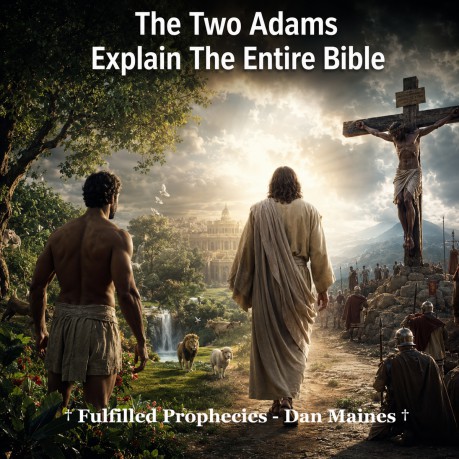
The Two Adams Explain The
Entire Bible Introduction Genesis 1:26-28 Genesis 2:8-9 Genesis 2:21-24 Genesis 3:17-19 Genesis 3:22-24 Romans 5:12, 18-19 1 Corinthians 15:21-22 1 Corinthians 15:45-49 2 Corinthians 5:17 Revelation 21:1-3 Revelation 22:1-5 Historical References How It Applies To Us Today Q & A Appendix Q: Does the Adam-Christ comparison really connect
Genesis with Revelation? Q: What does being in Christ mean? Q: Has the New Creation already begun? Q: Why does Revelation bring back the tree of
life? Q: What's the simplest way to understand the two
Adams? † This is the fulfilled perspective we proclaim at
Fulfilled Prophecies † Source Index
By Dan Maines
† The
Bible's story can be understood through two representative men, Adam
and Jesus Christ. The first Adam stands at the beginning of the old
creation, and Christ, the last Adam, stands at the beginning of the
New Creation.
† This isn't merely a
comparison Paul happened to make in Romans 5 and 1 Corinthians 15.
The two Adams reveal the structure of the biblical story, creation,
image, garden, tree, bride, dominion, sin, death, exile,
resurrection, and New Creation.
† Genesis
begins with a man, a garden, a bride, a tree, and access to God's
presence. Revelation ends with God's people, a bride, the tree of
life, restored dominion, and unrestricted access to God's presence
(Genesis 2:8-9, 18-24; Revelation 21:2-3; 22:1-5).
†
What Adam lost through disobedience, Christ recovered through
obedience. Where Adam brought condemnation and death, Christ brought
justification and life (Romans 5:18-19).
†
The Bible therefore isn't a collection of disconnected religious
stories. It's one continuous redemptive story moving from Adam to
Christ, from creation to New Creation, and from exile from God's
presence to restored fellowship with God.
Then God said, "Let Us
make mankind in Our image, according to Our likeness; and let them
rule over the fish of the sea and over the birds of the sky and over
the livestock and over all the earth, and over every crawling thing
that crawls on the earth." So God created man in His own image,
in the image of God He created him; male and female He created them.
God blessed them; and God said to them, "Be fruitful and
multiply, and fill the earth, and subdue it; and rule over the fish
of the sea and over the birds of the sky and over every living thing
that moves on the earth."
† Adam was
created in God's image and commissioned to exercise dominion.
Humanity's original calling involved representing God's rule within
His creation (Psalm 8:4-6).
† Sin damaged
humanity's faithful expression of that calling, but Christ appears as
the perfect image of God. What humanity failed to display in Adam is
perfectly revealed in Christ (Colossians 1:15; Hebrews 1:3).
†
This makes the image of God theme much larger than Genesis alone. The
story moves from humanity created in God's image to a redeemed people
being renewed according to the image of Christ (Romans 8:29;
Colossians 3:10).
The Lord God planted a garden
toward the east, in Eden; and there He placed the man whom He had
formed. Out of the ground the Lord God caused every tree to grow that
is pleasing to the sight and good for food; the tree of life was also
in the midst of the garden, and the tree of the knowledge of good and
evil.
† Eden was more than beautiful scenery.
It was the place where humanity lived in fellowship with God, and the
tree of life represented life in God's presence (Genesis 3:8, 22).
†
The tree of life disappears from humanity's reach after Adam's fall,
but it appears again at the end of Revelation. That isn't accidental.
Revelation deliberately brings the biblical story back to its Genesis
beginning (Revelation 22:2, 14).
† Genesis
shows humanity expelled from the place of life. Revelation shows
redeemed humanity restored to the presence of God and the tree of
life. The story that begins in a garden reaches its goal in the New
Jerusalem (Revelation 21:2-3; 22:1-5).
So the Lord God caused a
deep sleep to fall upon the man, and he slept; then He took one of
his ribs and closed up the flesh at that place. And the Lord God
fashioned into a woman the rib which He had taken from the man, and
brought her to the man. Then the man said, "At last this is bone
of my bones, And flesh of my flesh; She shall be called 'woman,'
Because she was taken out of man." For this reason a man shall
leave his father and his mother, and be joined to his wife; and they
shall become one flesh.
† The first Adam is
presented with his bride, and Paul later uses this marriage pattern
to explain Christ and His church (Ephesians 5:31-32).
†
The biblical bride theme therefore begins in Genesis and reaches its
climax in Revelation. Scripture moves from Adam and his bride to
Christ and His bride, the New Jerusalem (Revelation 19:7; 21:2,
9-10).
† The first marriage wasn't an
isolated event. Paul explicitly says the one-flesh mystery ultimately
speaks of Christ and the church (Ephesians 5:31-32).
Then to Adam He said,
"Because you have listened to the voice of your wife, and have
eaten from the tree about which I commanded you, saying, 'You shall
not eat from it'; Cursed is the ground because of you; With hard
labor you shall eat from it All the days of your life. Both thorns
and thistles it shall grow for you; Yet you shall eat the plants of
the field; By the sweat of your face You shall eat bread, Until you
return to the ground, Because from it you were taken; For you are
dust, And to dust you shall return."
†
Adam's disobedience introduced death into the human story. Paul
directly connects Adam's sin with sin and death entering the world
(Romans 5:12).
† Adam stood before a tree and
disobeyed God. Christ went obediently to a tree and remained faithful
even to death (Philippians 2:8; 1 Peter 2:24).
†
The contrast couldn't be stronger. Adam's act brought condemnation,
while Christ's righteous act brought justification of life (Romans
5:18).
† Even the thorns of Genesis reappear
in the passion of Christ when the soldiers place a crown of thorns on
His head (Matthew 27:29). The imagery of Adam's curse surrounds the
suffering of the last Adam.
Then the Lord God said,
"Behold, the man has become like one of Us, knowing good and
evil; and now, he might reach out with his hand, and take fruit also
from the tree of life, and eat, and live forever"- therefore the
Lord God sent him out of the Garden of Eden, to cultivate the ground
from which he was taken. So He drove the man out; and at the east of
the Garden of Eden He stationed the cherubim and the flaming sword
which turned every direction to guard the way to the tree of life.
†
Adam's story becomes a story of exile. Sin drove humanity away from
the garden sanctuary and barred access to the tree of life.
†
Exile then becomes one of Scripture's major patterns. Israel would
later experience national exile after covenant disobedience,
repeating Adam's pattern on a larger scale (Deuteronomy 28:63-64; 2
Kings 17:18-23).
† Redemption therefore isn't
merely about forgiveness. It's about restored access to God.
Revelation closes with the servants of God seeing His face, exactly
where the biblical story was always heading (Revelation 22:3-4).
Therefore, just as
through one man sin entered into the world, and death through sin,
and so death spread to all mankind, because all sinned - So then, as
through one offense the result was condemnation to all mankind, so
also through one act of righteousness the result was justification of
life to all mankind. For as through the one man's disobedience the
many were made sinners, so also through the obedience of the One the
many will be made righteous.
† Paul
interprets the human story through two representative men. Adam
represents disobedience, condemnation, sin, and death. Christ
represents obedience, righteousness, justification, and life.
†
The decisive contrast isn't simply between bad behavior and good
behavior. It's between two covenant heads and the worlds associated
with them (1 Corinthians 15:22, 45-49).
†
Adam's failure explains why redemption required more than repairing
humanity's behavior. Humanity needed a new representative, a faithful
man who would succeed where the first man failed.
†
Jesus didn't merely undo isolated consequences of Adam's sin. He
established a new humanity characterized by righteousness and life (2
Corinthians 5:17; Ephesians 2:15).
For since by a man
death came, by a Man also came the resurrection of the dead. For as
in Adam all die, so also in Christ all will be made alive.
†
Paul places resurrection directly inside the Adam-Christ story. Death
came through the first man, and resurrection comes through Christ.
†
This means resurrection isn't disconnected from Genesis. It's God's
answer to the death introduced in Adam's world (Romans 5:12-21).
†
Paul's categories are corporate, in Adam and in Christ. The movement
is from the humanity identified with Adam and death into the humanity
identified with Christ and life (Romans 6:4-11).
†
The resurrection of Christ announced that the age of the last Adam
had begun. Jesus emerged from death as the firstfruits of the
resurrection harvest (1 Corinthians 15:20).
So also it is
written: "The first man, Adam, became a living person." The
last Adam was a life-giving spirit. However, the spiritual is not
first, but the natural; then the spiritual. The first man is from the
earth, earthy; the second Man is from heaven. As is the earthy one,
so also are those who are earthy; and as is the heavenly One, so also
are those who are heavenly. Just as we have borne the image of the
earthy, we will also bear the image of the heavenly.
†
Paul explicitly calls Jesus the last Adam. This isn't a title we have
imposed on Scripture. It's the inspired interpretation of Christ's
place in the biblical story.
† Notice Paul's
return to the theme of image. Genesis began with humanity created in
God's image, and Paul describes the redemptive movement from bearing
the image of the earthly man to bearing the image of the heavenly
man.
† Christ isn't merely another Adam who
starts another temporary cycle. He's the last Adam. God's redemptive
purpose reaches its goal in Him (2 Corinthians 1:20).
†
The old humanity found its identity in Adam. The New Creation
humanity finds its identity in Christ.
Therefore if anyone is in
Christ, this person is a new creation; the old things passed away;
behold, new things have come.
† New Creation
isn't merely a future renovation of physical matter. Paul said that
those who are in Christ participate in New Creation.
†
Notice the connection with Paul's Adam theology. Humanity was once
defined by being in Adam, but believers are now defined by being in
Christ (1 Corinthians 15:22; Romans 8:1).
†
The New Creation began in Christ and extends to those united with
Him. God's answer to the old humanity isn't another version of Adam's
world, it's a new humanity in the last Adam (Ephesians 2:10, 15).
†
This is why the New Testament repeatedly speaks of putting off the
old man and putting on the new man, who is being renewed according to
the image of the Creator (Ephesians 4:22-24; Colossians 3:9-10).
Then I saw a new heaven
and a new earth; for the first heaven and the first earth passed
away, and there is no longer any sea. And I saw the holy city, new
Jerusalem, coming down out of heaven from God, prepared as a bride
adorned for her husband. And I heard a loud voice from the throne,
saying, Behold, the tabernacle of God is among the people, and He
will dwell among them, and they shall be His people, and God Himself
will be among them,
† Revelation brings
together New Creation, bride, dwelling, and restored divine presence.
These themes reach backward through the entire Bible to Genesis.
†
Genesis begins with God dwelling with humanity in a garden.
Revelation ends with God's dwelling established with His people. The
Bible has traveled from lost presence to restored presence.
†
The bride introduced through Adam's marriage pattern reaches her
covenant fulfillment in the New Jerusalem, the bride of the Lamb
(Ephesians 5:31-32; Revelation 21:9-10).
†
The direction is also important. New Jerusalem comes down from heaven
from God. The biblical goal isn't humanity permanently escaping God's
creation, it's God dwelling with His redeemed people.
And he showed me a river
of the water of life, clear as crystal, coming from the throne of God
and of the Lamb, in the middle of its street. On either side of the
river was the tree of life, bearing twelve kinds of fruit, yielding
its fruit every month; and the leaves of the tree were for the
healing of the nations. There will no longer be any curse; and the
throne of God and of the Lamb will be in it, and His bond-servants
will serve Him; they will see His face, and His name will be on their
foreheads. And there will no longer be any night; and they will not
have need of the light of a lamp nor the light of the sun, because
the Lord God will illuminate them; and they will reign forever and
ever.
† Here the Bible deliberately returns
to Genesis. The tree of life is back. The curse is removed. God's
presence is unrestricted. His servants reign. The themes lost through
Adam are restored through Christ.
† Adam lost
access to the tree of life, but Revelation shows the tree available
within the New Jerusalem. Adam experienced the curse, but Revelation
declares that the curse is gone.
† Adam was
commissioned to exercise dominion, and Revelation ends with God's
servants reigning. The dominion theme that began in Genesis reaches
its redemptive goal in the kingdom of Christ (Genesis 1:26-28;
Revelation 22:5).
† Adam hid from God's
presence, but God's servants now see His face (Genesis 3:8-10;
Revelation 22:4).
† Genesis and Revelation
aren't two unrelated books sitting at opposite ends of the Bible.
Revelation completes the story Genesis began. Garden, tree, bride,
image, dominion, death, exile, life, and divine presence all find
their resolution in Christ.
†
Irenaeus, writing in the second century, developed the Adam-Christ
parallel extensively in Against Heresies. He described Christ as
retracing humanity's story and succeeding in obedience where Adam had
failed.
† Justin Martyr also contrasted
Adam's disobedience with Christ's obedience and recognized Christ's
work as the reversal of humanity's fall.
†
Augustine later emphasized the two-humanity structure found in Paul,
humanity associated with Adam through sin and death, and redeemed
humanity receiving life through Christ.
†
These historical witnesses didn't create Paul's Adam-Christ theology.
They demonstrate that early Christians recognized the connection
between Genesis, Adam, Christ, redemption, and restored life.
†
We don't live waiting for another Adam. Jesus is the last Adam, and
God's New Creation has already been inaugurated in Him (1 Corinthians
15:45; 2 Corinthians 5:17).
† Our identity
isn't ultimately determined by Adam's failure. Those who belong to
Christ are identified with the One who conquered sin and death and
brought life (Romans 5:17-19).
† We don't
need to search for another physical Eden. God's presence is with His
covenant people, and believers have access to Him through Christ
(Ephesians 2:18; Hebrews 10:19-22).
† We live
as New Creation people now. We're being renewed according to the
image of our Creator and conformed to the image of His Son (Romans
8:29; Colossians 3:10).
† The Bible's story
gives us confidence about where we stand. Adam isn't the final word.
Exile isn't the final word. Death isn't the final word. Christ is the
last Adam, resurrection has come through Him, and New Creation is the
world of the New Covenant.
† When we read
Scripture from Genesis to Revelation through the two Adams, the
pieces come together. The garden leads to the city, the first bride
points toward the Lamb's bride, the forbidden tree gives way to the
cross and the restored tree of life, exile gives way to access, death
gives way to life, and Adam gives way to Christ.
Q: Why
does Paul call Jesus the last Adam?
A: Because
Jesus stands as the head of a new humanity. The first Adam brought
sin and death through disobedience, while Christ brought
righteousness and life through obedience (Romans 5:18-19; 1
Corinthians 15:45).
A: Yes. Genesis
introduces the tree of life, bride, dominion, curse, and God's
presence. Revelation closes with the tree of life, the bride,
restored reign, removal of the curse, and God's presence with His
people (Genesis 1:26-28; 2:8-9, 21-24; Revelation 21:2-3; 22:1-5).
A:
It means our covenant identity is found in Christ rather than Adam.
Paul contrasts being in Adam with being in Christ and describes those
in Christ as New Creation (1 Corinthians 15:22; 2 Corinthians 5:17).
A:
Yes. Paul said, "if any man is in Christ, he is a new creature."
New Creation is already a present reality in Christ and His people (2
Corinthians 5:17; Galatians 6:15).
A: Because Revelation completes Genesis.
Humanity was barred from the tree after Adam's fall, but the tree
appears again in New Jerusalem, showing restored life and fellowship
with God through Christ (Genesis 3:22-24; Revelation 22:1-5).
A: Adam explains the entrance of sin,
condemnation, exile, and death. Christ explains righteousness,
justification, restoration, resurrection, and New Creation (Romans
5:12-21; 1 Corinthians 15:21-22, 45-49).
© Fulfilled Prophecies - Dan
Maines.
† Genesis
1:26-28; Genesis 2:8-9; Genesis 2:21-24; Genesis 3:17-19; Genesis
3:22-24; Romans 5:12, 18-19; 1 Corinthians 15:21-22; 1 Corinthians
15:45-49; 2 Corinthians 5:17; Revelation 21:1-3; Revelation 22:1-5
†
Historical writers: Irenaeus, Against Heresies; Justin Martyr;
Augustine
Links