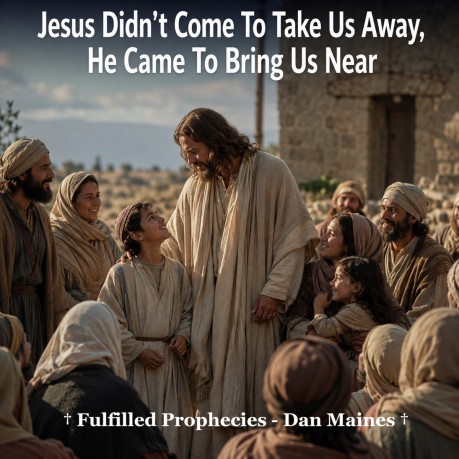
Jesus Didn't Come To Take Us
Away, He Came To Bring Us Near Introduction John 14:23 Ephesians 2:13 Ephesians 2:18 Hebrews 12:22-24 Revelation 21:3 Revelation 22:3-4 Historical References How It Applies To Us Today Q & A Appendix Q: Doesn't Revelation teach that believers
eventually leave the earth for heaven? Q: Are Christians still waiting to be brought
near to God? Q: Have believers already come to the heavenly
Jerusalem? Q: Where does God dwell today? Q: Then what is the great hope of fulfilled
eschatology? † This is the fulfilled perspective we proclaim at
Fulfilled Prophecies † Source Index
By Dan Maines
† Much
end-times teaching has made the Christian hope about escaping the
earth. The picture often presented is that Jesus came to prepare a
way for believers to leave this world behind. But when we follow the
biblical story from beginning to end, we find something much greater.
God's purpose wasn't primarily to take His people away from His
creation, it was to remove the separation between God and His
people.
† The story begins with humanity
separated from God's presence, but it ends with God dwelling with His
people. The direction of redemption isn't humanity getting farther
away from earth, it's humanity being brought near to God.
†
This is one of the great WOW moments of fulfilled eschatology. Jesus
didn't come merely to change our location. He came to change our
relationship with God. The goal wasn't evacuation, it was
reconciliation. The goal wasn't distance, it was access. The goal
wasn't escaping God's creation, it was dwelling in God's presence.
†
Jesus even prayed that the Father wouldn't take His disciples out of
the world, but would keep them from the evil one (John 17:15). His
prayer wasn't for their removal from the world, but for their
protection while they remained in it.
† The
New Testament repeatedly describes salvation as being brought near,
receiving access to the Father, becoming God's dwelling place, coming
to the heavenly Jerusalem, and finally seeing God's face. That's the
direction of the biblical story.
Jesus answered and said to him,
If anyone loves Me, he will follow My word; and My Father will love
him, and We will come to him and make Our dwelling with him.
†
Notice the direction. Jesus didn't say that the believer must travel
away from the earth to find God. Jesus said, we will come to him. The
movement described here is God coming to dwell with His people.
†
Jesus promised that the Father and Son would make their dwelling with
the believer. This is covenant presence, not geographical evacuation.
God's purpose was fellowship restored through Christ (John 14:20;
17:21-23).
† This also helps explain Jesus'
promise concerning the Father's house. The emphasis of John 14 isn't
simply believers going somewhere else, but believers being received
into fellowship with Christ. Only a few verses later Jesus explains
this relationship as the Father and Son coming and making their
dwelling with the believer (John 14:2-3, 20, 23).
†
The great promise of Christ is therefore much bigger than leaving the
earth. Through Him, the separation caused by sin has been overcome,
and God's people have been brought into communion with the Father.
But now in Christ Jesus you
who previously were far away have been brought near by the blood of
Christ.
† Paul describes salvation with two
powerful ideas, far away and brought near. The problem wasn't that
believers were physically located too far from heaven. The problem
was covenant separation from God.
† Christ's
blood changed that condition. Those who were far away were brought
near. This is accomplished redemption, not a promise that Christians
must wait for a future escape from the earth (Ephesians 2:11-16).
†
Jesus didn't die so God's people could spend thousands of years
waiting to become near to God. Through Christ, they were already
being reconciled to God and brought into His covenant family
(Ephesians 2:19).
† That's the WOW moment.
The gospel isn't primarily God saying, Someday I'll take you away
from here. The gospel announces that through Christ, those who were
far away have been brought near.
for through Him we both have
our access in one Spirit to the Father.
†
Paul doesn't say that believers will someday have access to the
Father after they're removed from the earth. He says we have our
access. Access to God is a present reality through Christ.
†
Under the old covenant, access to God's presence was pictured through
priests, sacrifices, the temple, and the veil. Christ fulfilled what
those things represented and opened the way into God's presence
(Hebrews 9:8-12; 10:19-22).
† Jew and Gentile
now share the same access to the Father through the same Spirit.
God's dwelling is no longer centered in a physical temple made with
human hands. His people are being built together into a dwelling
place of God in the Spirit (Ephesians 2:19-22).
†
Christianity isn't a religion of standing outside waiting to get in.
In Christ, we have access.
But you have come to Mount
Zion and to the city of the living God, the heavenly Jerusalem, and
to myriads of angels, to the general assembly and church of the
firstborn who are enrolled in heaven, and to God, the Judge of all,
and to the spirits of the righteous made perfect, and to Jesus, the
mediator of a new covenant, and to the sprinkled blood, which speaks
better than the blood of Abel.
† The writer
doesn't tell these believers that they must wait thousands of years
to come to Mount Zion. He tells them, you have come. They were
participating in the transition from the old covenant order to the
heavenly reality established through Christ.
†
They had come to the city of the living God, the heavenly Jerusalem.
This wasn't describing an airplane trip into the sky. It was
describing covenant access to God through Jesus, the mediator of the
new covenant (Hebrews 8:6-13).
† This passage
completely changes the direction of the discussion. The Christian
hope isn't centered on escaping God's creation. God's people have
been brought into the heavenly Jerusalem and into the presence of God
through Christ.
† What the earthly Jerusalem,
temple, priesthood, and sacrifices pictured temporarily, Christ
brought into reality permanently.
And I heard a loud voice
from the throne, saying, Behold, the tabernacle of God is among the
people, and He will dwell among them, and they shall be His people,
and God Himself will be among them,
† Here is
the direction of the entire biblical story stated plainly. The
tabernacle of God is with humanity. God dwells with His people.
†
Revelation doesn't end with the declaration that humanity has finally
escaped God's creation. It ends with God's dwelling being with His
people. The separation pictured throughout the old covenant order has
been removed through Christ.
† The language
reaches back through the entire covenant story. The tabernacle and
temple represented God's presence among His covenant people, but
those structures were shadows pointing toward something greater
(Exodus 25:8; Ezekiel 37:27; Hebrews 8:1-5).
†
In the fulfilled new covenant reality, God's presence isn't confined
to a building in Jerusalem. God's dwelling is with His people.
There will no longer be
any curse; and the throne of God and of the Lamb will be in it, and
His bond-servants will serve Him; they will see His face, and His
name will be on their foreheads.
† The Bible
begins with humanity losing unhindered access to God's presence, and
Revelation ends with God's servants seeing His face. That's
restoration.
† The throne of God and the Lamb
is present with His people. The curse associated with covenant
separation has been overcome through the victorious work of Christ
(Galatians 3:13; Revelation 21:1-4).
† Seeing
God's face communicates restored fellowship, acceptance, and covenant
presence. What humanity couldn't accomplish through law, sacrifice,
priesthood, or temple was accomplished through Jesus Christ.
†
This is where the biblical story was always going. Not God abandoning
His people. Not God's people endlessly waiting to escape. God and His
people dwelling together.
†
Josephus recorded the catastrophic destruction of Jerusalem and the
temple in AD 70, describing the burning of the sanctuary and the
collapse of the old Jewish center of worship. This historical
judgment provides the setting for understanding the final removal of
the old covenant temple order (Josephus, Wars of the Jews, Books
6-7).
† Eusebius later recorded that the
believers in Jerusalem left the city before the war and went to
Pella. His account is significant because the Christians didn't
remain attached to earthly Jerusalem as though God's presence
depended upon that city or its temple (Eusebius, Ecclesiastical
History, Book 3, Chapter 5).
† The
destruction of the earthly temple didn't leave God's people without
God's presence. The New Testament had already declared that believers
were God's temple and dwelling place through the Spirit (1
Corinthians 3:16; Ephesians 2:19-22).
† The
historical end of the temple system therefore fits the theological
movement already announced throughout the New Testament, from the
earthly shadow to the completed new covenant reality in Christ.
†
We don't have to live as though God is far away. Through Jesus
Christ, believers have access to the Father (Ephesians 2:18).
†
We don't have to look toward earthly Jerusalem to find God's dwelling
place. God's people are His dwelling place through the Spirit
(Ephesians 2:19-22).
† We don't have to build
our Christian hope around escaping the earth. Jesus prayed that His
disciples wouldn't be taken out of the world, but that they would be
kept from the evil one (John 17:15).
† We can
live with joy because Christianity isn't about waiting outside God's
presence. In Christ, we've been brought near.
†
We can live with confidence because Jesus accomplished
reconciliation. The distance between God and His covenant people has
been overcome through Christ (2 Corinthians 5:18-19).
†
We can live with peace because the kingdom isn't waiting for some
future generation to discover it. God's people have received a
kingdom that can't be shaken (Hebrews 12:28).
†
We can live every day knowing that God's purpose wasn't to abandon
His creation or leave His people waiting for an evacuation. His
purpose was communion, reconciliation, access, and dwelling.
†
That's the WOW moment. The story isn't about how far away Christians
can someday go. It's about how near God has brought us through
Jesus.
† Jesus didn't come to take us away,
He came to bring us near.
Q:
Didn't Jesus say He was going to prepare a place and come again to
receive His disciples to Himself?
A: Yes. But
the surrounding context explains the purpose as union and fellowship
with Christ, not simply transportation away from the earth. Jesus
said, I will come to you, and then said that the Father and Son would
come and make their dwelling with the believer (John 14:2-3, 18, 20,
23).
A:
Revelation's closing picture emphasizes the opposite direction, God's
dwelling is with His people. The New Jerusalem comes down from God,
and God's tabernacle is with humanity (Revelation 21:2-3).
A: No. Paul said those who were
far away had already been brought near by the blood of Christ and
already had access to the Father (Ephesians 2:13, 18).
A: Yes. Hebrews says, you have come
to Mount Zion, the city of the living God, the heavenly Jerusalem
(Hebrews 12:22-24).
A:
God dwells with and in His people through the Spirit. Believers are
described as being built together into a dwelling of God in the
Spirit (Ephesians 2:19-22).
A: It's not that we're waiting for
God to finish an unfinished redemption. It's that we live in the
reality Christ accomplished, reconciliation, access to the Father,
the new covenant, the kingdom, and fellowship with God (Hebrews
12:22-24, 28; Revelation 21:3).
© Fulfilled Prophecies - Dan
Maines.
† John
14:23; Ephesians 2:13; Ephesians 2:18; Hebrews 12:22-24; Revelation
21:3; Revelation 22:3-4
† Historical writers:
Josephus, Wars of the Jews, Books 6-7; Eusebius, Ecclesiastical
History, Book 3, Chapter 5
Links