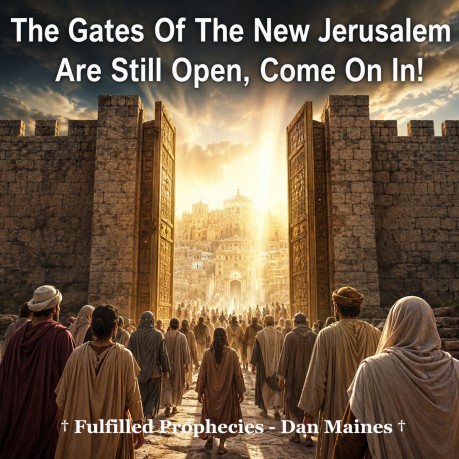
The Gates Of The New
Jerusalem Are Still Open, Come On In! Introduction Revelation 21:2-3 Revelation 21:22-24 Revelation 21:25-27 Revelation 22:1-2 Revelation 22:14 Revelation 22:17 Hebrews 12:22-24 Historical References How It Applies To Us Today Q & A Appendix Q: Why would the gates need to remain open if
everyone were already inside? Q: Does this mean everyone automatically enters
the New Jerusalem? Q: Are Christians still supposed to invite people
to Christ if prophecy has been fulfilled? Q: Are we waiting for the New Jerusalem to come
down someday? Q: What is the great message for us today? † This is the fulfilled perspective we proclaim at
Fulfilled Prophecies † Source Index
By Dan Maines
† Revelation
doesn't end with God's people standing outside a locked city waiting
for the New Jerusalem to arrive someday.
† It
ends with the New Jerusalem present, its gates open, the river of
life flowing, the tree of life available, and an invitation still
going out to those who are thirsty (Revelation 21:2-3; 22:1-2, 17).
†
This is one of the great WOW moments of fulfilled eschatology. The
gates aren't waiting to open. Revelation says they will never be
shut.
† If the gates are open and people are
still being invited to enter, the New Jerusalem can't simply describe
heaven after the physical universe has ended. The picture is of God's
completed covenant city welcoming people into the life, fellowship,
and presence of God.
† The fulfilled New
Jerusalem isn't an empty future city. It is the present covenant
reality of God's people in Christ, and the invitation is still going
out today (Hebrews 12:22-24; Galatians 4:26).
And I saw the holy city,
new Jerusalem, coming down out of heaven from God, prepared as a
bride adorned for her husband. And I heard a loud voice from the
throne, saying, Behold, the tabernacle of God is among the people,
and He will dwell among them, and they shall be His people, and God
Himself will be among them,
† Notice the
direction of the city. John didn't describe God's people escaping the
earth to reach the city. He saw the New Jerusalem coming down from
God (Revelation 21:2).
† The central promise
is God's dwelling with His people. The New Jerusalem represents
restored fellowship, covenant relationship, and access to God through
Christ (Ephesians 2:18-22).
† The city is
also identified with the bride. Revelation isn't merely describing
buildings, streets, walls, and gates. It is describing God's redeemed
covenant people in the language of a glorious city (Revelation
21:9-10).
I saw no temple in it,
for the Lord God the Almighty and the Lamb are its temple. And the
city has no need of the sun or of the moon to shine on it, for the
glory of God has illuminated it, and its lamp is the Lamb. The
nations will walk by its light, and the kings of the earth will bring
their glory into it.
† There is no physical
temple in this city because access to God is no longer centered in
the old temple system. God and the Lamb are its temple (John
4:21-24).
† Notice something remarkable, the
nations are still present and walking by the city's light. This is a
functioning kingdom picture, not a picture of evangelism being
finished because human history has ended (Revelation 22:2).
†
The New Jerusalem shines outward. God's people aren't hidden from the
nations. The nations are pictured as benefiting from the light that
comes from God and the Lamb (Matthew 5:14-16).
In the daytime (for
there will be no night there) its gates will never be closed; and
they will bring the glory and the honor of the nations into it; and
nothing unclean, and no one who practices abomination and lying,
shall ever come into it, but only those whose names are written in
the Lamb's book of life.
† Here is the WOW
moment, the gates will never be shut. An open gate means access. The
completed city remains open to those who come to God through Christ
(John 10:9).
† Revelation still distinguishes
between those inside and those outside. That distinction makes sense
in the fulfilled kingdom because people continue to be called from
darkness into the light of Christ (Revelation 22:14-15).
†
The nations continue bringing their glory and honor into the city.
The imagery isn't of a city waiting to descend thousands of years
later, it is of an established kingdom receiving people from the
nations (Isaiah 60:3, 11).
† The open gates
beautifully display the continuing reach of the gospel. The kingdom
has been established, Christ reigns, and people can still enter
through faith in Him (Colossians 1:13).
And he showed me a river
of the water of life, clear as crystal, coming from the throne of God
and of the Lamb, in the middle of its street. On either side of the
river was the tree of life, bearing twelve kinds of fruit, yielding
its fruit every month; and the leaves of the tree were for the
healing of the nations.
† The river of life
is flowing from God's throne. Life isn't pictured as scarce or
inaccessible. God's life flows outward from His completed kingdom
(John 7:37-39).
† The tree of life appears
again, showing the restoration of what humanity lost in Eden.
Revelation moves from paradise lost to paradise restored in Christ
(Genesis 3:22-24).
† The leaves are for the
healing of the nations. Nations that receive healing must still exist
to receive it. This strongly supports an ongoing kingdom reality
rather than a picture occurring only after earthly history has
disappeared.
† Fulfillment didn't end God's
work among people. Fulfillment established the completed covenant
order through which the life of Christ continues reaching the nations
(Matthew 28:18-20).
Blessed are those who wash
their robes, so that they will have the right to the tree of life,
and may enter the city by the gates.
† People
enter the city through its gates. The language is active, there is a
city already presented, gates available for entrance, and people
receiving the right to enter.
† The blessing
isn't merely that the city exists. The blessing is participation in
its life, access to the tree of life, and entrance into God's
covenant presence (Revelation 22:2).
† Jesus
is the way into fellowship with the Father. Entrance isn't based on
ethnicity, geography, or belonging to old covenant Jerusalem. Access
is through Christ (John 14:6; Ephesians 2:18).
The Spirit and the bride
say, "Come." And let the one who hears say, "Come."
And let the one who is thirsty come; let the one who desires, take
the water of life without cost.
† Revelation
doesn't close by saying, Wait for the city. It closes with an
invitation, Come.
† The bride herself says,
Come. That is significant because the bride has already been
identified with the New Jerusalem (Revelation 21:2, 9-10).
†
The thirsty are invited to drink freely from the water of life. The
river isn't locked behind gates that won't open until the end of
human history. The invitation is available because God's redemptive
work in Christ has been accomplished (John 4:13-14).
†
This is why fulfilled eschatology doesn't leave us without hope or
mission. Fulfillment means the promised kingdom has arrived, God's
dwelling is with His people, and we can invite others to enjoy what
Christ accomplished.
But you have come to Mount
Zion and to the city of the living God, the heavenly Jerusalem, and
to myriads of angels, to the general assembly and church of the
firstborn who are enrolled in heaven, and to God, the Judge of all,
and to the spirits of the righteous made perfect, and to Jesus, the
mediator of a new covenant, and to the sprinkled blood, which speaks
better than the blood of Abel.
† Hebrews
doesn't tell believers that they will someday come to Mount Zion and
the heavenly Jerusalem. It says they had come to it.
†
The heavenly Jerusalem was already becoming their covenant reality as
the old covenant age approached its complete removal (Hebrews 8:13;
10:37).
† Revelation shows that reality in
its completed form. Hebrews announces access to the heavenly
Jerusalem, and Revelation shows the city with gates that will never
be shut.
† We aren't waiting for another
covenant city. Through Jesus, the mediator of the new covenant, God's
people have access to the city of the living God.
†
Josephus described the catastrophic destruction of Jerusalem and its
temple in AD 70, recording the collapse of the city that had stood at
the center of the old covenant world (Josephus, Wars of the Jews,
Books 5-7).
† Josephus' account provides
important historical background for understanding the contrast
between old Jerusalem under judgment and the heavenly Jerusalem that
couldn't be destroyed by Roman armies (Hebrews 12:26-28).
†
Eusebius later recorded the tradition that believers in Jerusalem
departed before the war and settled at Pella, connecting the
first-century Christian community with the events surrounding
Jerusalem's judgment (Eusebius, Ecclesiastical History 3.5).
†
These historical witnesses don't establish the doctrine by
themselves. Scripture establishes the doctrine, while history helps
us see the first-century setting in which those judgment prophecies
reached their fulfillment.
†
We don't have to spend our lives waiting outside the New Jerusalem.
In Christ, God's people belong to the heavenly city (Hebrews
12:22-24).
† We don't have to wonder whether
the gates are open. Revelation says they will never be shut
(Revelation 21:25).
† We don't have to tell
thirsty people to wait for another age before they can drink. The
invitation is still, Come, take the water of life freely (Revelation
22:17).
† We can proclaim a kingdom that is
here, a King who reigns, a new covenant that is established, and
access to God that is available through Jesus Christ (Hebrews
10:19-22).
† Fulfilled prophecy isn't the end
of the good news. Fulfillment is why we can announce the good news
with confidence.
† The gates are open. The
water of life is flowing. The invitation is going out. The King is
reigning.
† Come on in!
Q: If
the New Jerusalem is already a present reality, why are people still
entering it?
A: Because fulfillment established
the kingdom, it didn't end the growth of the kingdom. Revelation
pictures open gates, nations, healing, and an ongoing invitation to
come and drink from the water of life (Revelation 21:25-27; 22:2,
17).
A: That's
precisely the point. The imagery presents continuing access. People
outside are still invited to enter, while the gates of God's covenant
city remain open (Revelation 21:25; 22:14-17).
A: No. Revelation
distinguishes those who enter from those who remain outside. Entrance
is connected with belonging to Christ and receiving the life He gives
(Revelation 21:27; 22:14-15; John 14:6).
A:
Absolutely. Fulfilled prophecy doesn't mean the gospel has stopped.
Revelation ends with the Spirit and the bride saying, Come, and
whoever is thirsty is invited to take the water of life freely
(Revelation 22:17).
A: No. Hebrews told first-century
believers that they had already come to Mount Zion and the heavenly
Jerusalem, and Revelation portrays the completed city with
permanently open gates (Hebrews 12:22-24; Revelation 21:25).
A:
We aren't waiting for God's kingdom to open. Christ has accomplished
redemption, the new covenant is established, access to God is
available, and the invitation still stands, Come (Hebrews 10:19-22;
Revelation 22:17).
© Fulfilled Prophecies - Dan
Maines.
† Revelation
21:2-3; Revelation 21:22-24; Revelation 21:25-27; Revelation 22:1-2;
Revelation 22:14; Revelation 22:17; Hebrews 12:22-24
†
Josephus, Wars of the Jews, Books 5-7; Eusebius, Ecclesiastical
History 3.5
Links