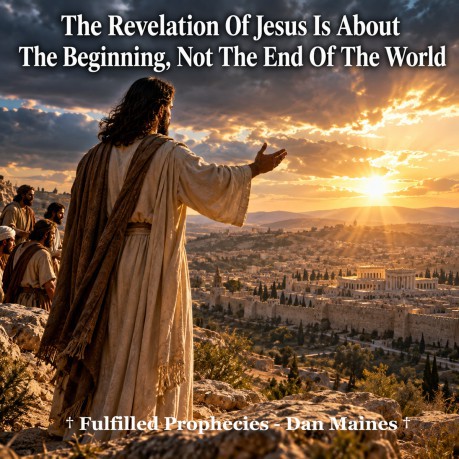
The Revelation Of Jesus Is
About The Beginning, Not The End Of The World Introduction Revelation 1:1-3 Revelation 3:12 Revelation 11:8 Revelation 18:20 Revelation 19:6-7 Revelation 21:1-3 Revelation 21:22-24 Revelation 22:1-2 Revelation 22:14-17 Revelation 22:6-7 Historical References How It Applies To Us Today Q & A Appendix Q: What ended in Revelation? Q: Why does Revelation describe a new heaven and
new earth? Q: If Revelation describes the end of history,
why are nations still present? Q: Are believers waiting to enter the heavenly
Jerusalem? Q: What is the central message of Revelation for
us today? † This is the fulfilled perspective we proclaim at
Fulfilled Prophecies †
By Dan Maines
† Revelation
isn't a book about the end of planet Earth. It's the revelation of
Jesus Christ, the judgment of the old covenant world, and the full
establishment of the new covenant order.
†
The book begins by telling its original readers that the events must
shortly come to pass and that the time was near. Those statements
establish the time frame of the prophecy before any symbol is
interpreted.
† Revelation moves from an old
creation under judgment to a new creation in Christ. It ends with the
New Jerusalem, the dwelling of God with His people, the river of
life, the tree of life, and the nations receiving healing.
†
This isn't the destruction of God's physical creation. It's the
completion of one covenant age and the revealed reality of another,
the kingdom of Jesus Christ that has no end (Luke 1:32-33).
The Revelation of Jesus
Christ, which God gave Him to show to His bond-servants, the things
which must soon take place; and He sent and communicated it by His
angel to His bond-servant John, who testified to the word of God and
to the testimony of Jesus Christ, everything that he saw. Blessed is
the one who reads, and those who hear the words of the prophecy and
keep the things which are written in it; for the time is near.
†
Revelation identifies itself as the revelation of Jesus Christ. Its
focus is Christ, His kingdom, His judgment, and the fulfillment of
God's covenant purposes.
† John didn't tell
his first-century readers that these things would happen thousands of
years later. He said they must shortly take place.
†
He reinforced that statement by saying the time was near. The
original audience was expected to hear, understand, and keep the
words because fulfillment was approaching (Revelation 22:6-7).
†
Any interpretation that moves the central events thousands of years
beyond John's audience has to deal honestly with the time statements
placed at both the beginning and end of the book (Revelation 22:10).
The one who overcomes, I
will make him a pillar in the temple of My God, and he will not go
out from it anymore; and I will write on him the name of My God, and
the name of the city of My God, the new Jerusalem, which comes down
out of heaven from My God, and My new name.
†
Before Revelation describes the New Jerusalem in its closing
chapters, Jesus had already promised His first-century believers that
they would bear the name of that city.
† The
New Jerusalem isn't presented merely as a city waiting at the end of
physical history. It represents God's covenant people in union with
Christ, the heavenly Jerusalem to which believers have come (Hebrews
12:22-24).
† Paul likewise identified the
Jerusalem above as free and as the mother of God's people (Galatians
4:26). Revelation develops that same covenant reality.
And their dead bodies will
lie on the street of the great city which spiritually is called Sodom
and Egypt, where also their Lord was crucified.
†
Revelation itself identifies the great city by telling us where the
Lord was crucified. Jesus was crucified at Jerusalem.
†
Calling that city Sodom and Egypt is covenant judgment language.
Jerusalem had become spiritually identified with the enemies from
whom God had once delivered His people.
†
Jesus had already announced judgment upon Jerusalem and said that all
the righteous blood being charged against that generation would come
upon it (Matthew 23:34-36).
† Revelation's
judgment isn't disconnected from Jesus' warnings. It develops the
same first-century judgment that Jesus said would come upon His
generation (Matthew 24:34).
Rejoice over her, O heaven,
and you saints and apostles and prophets, because God has pronounced
judgment for you against her.
† The judgment
of the harlot concerned the blood of God's apostles and prophets.
Jesus had already charged Jerusalem with killing the prophets and
persecuting those sent to her (Matthew 23:37).
†
Revelation describes the harlot as drunk with the blood of the saints
and witnesses of Jesus (Revelation 17:6). Jesus placed responsibility
for that persecution upon the Jerusalem of His generation (Luke
13:33-35).
† Her fall wasn't the end of the
physical world. It was covenant judgment upon the persecuting city
and the removal of the old order that opposed Christ and His people.
Then I heard something
like the voice of a great multitude and like the sound of many
waters, and like the sound of mighty peals of thunder, saying,
"Hallelujah! For the Lord our God, the Almighty, reigns. Let's
rejoice and be glad and give the glory to Him, because the marriage
of the Lamb has come, and His bride has prepared herself."
†
Revelation doesn't simply move toward destruction. It moves toward
marriage, kingdom, victory, and covenant fulfillment.
†
The judgment of the harlot is followed by the marriage of the Lamb.
The unfaithful covenant city falls, while the bride of Christ is
revealed in glory.
† This is why Revelation
is about a beginning as much as it is about an ending. The old
covenant order passes away, while the completed new covenant order
stands in Christ (Hebrews 8:13).
† Jesus
didn't establish a temporary kingdom waiting to disappear with planet
Earth. His kingdom has no end (Daniel 7:13-14).
Then I saw a new heaven
and a new earth; for the first heaven and the first earth passed
away, and there is no longer any sea. And I saw the holy city, new
Jerusalem, coming down out of heaven from God, prepared as a bride
adorned for her husband. And I heard a loud voice from the throne,
saying, Behold, the tabernacle of God is among the people, and He
will dwell among them, and they shall be His people, and God Himself
will be among them,
† Notice the direction.
The New Jerusalem comes down out of heaven. The story isn't about
God's people abandoning the earth. It's about God dwelling with His
people.
† The new heaven and new earth
describe the new covenant creation in which righteousness dwells and
God's people live in His presence.
† Isaiah
had already connected the new heavens and new earth with continuing
generations, people building houses, planting vineyards, having
descendants, and nations coming to worship God (Isaiah 65:17-25;
66:22-23).
† Revelation presents the bride as
the holy city. This is covenant language describing God's redeemed
people, not the replacement of the physical universe with another
planet.
I saw no temple in it,
for the Lord God the Almighty and the Lamb are its temple. And the
city has no need of the sun or of the moon to shine on it, for the
glory of God has illuminated it, and its lamp is the Lamb. The
nations will walk by its light, and the kings of the earth will bring
their glory into it.
† Revelation ends
without a physical temple because God's dwelling isn't centered in a
building. God and the Lamb are its temple.
†
The nations still exist and walk by the light of the city. Kings of
the earth bring their glory into it. That doesn't describe the end of
human history or the destruction of planet Earth.
†
The imagery describes the worldwide light and reign of Christ flowing
from the completed new covenant reality (Isaiah 60:1-3).
†
The Bible's story reaches its covenant goal, God dwelling with His
people through Jesus Christ.
And he showed me a river
of the water of life, clear as crystal, coming from the throne of God
and of the Lamb, in the middle of its street. On either side of the
river was the tree of life, bearing twelve kinds of fruit, yielding
its fruit every month; and the leaves of the tree were for the
healing of the nations.
† Revelation ends
with life flowing outward, not with creation disappearing.
†
The tree of life appears again, showing that what was lost in the
opening chapters of Genesis reaches its covenant fulfillment through
Christ.
† The nations receive healing from
the tree's leaves. Healing presupposes people outside the city who
may come to its light and receive its blessings.
†
Revelation therefore brings the biblical story from Eden to the New
Jerusalem, from separation to access, and from death to life in
Christ (John 10:10).
Blessed are those who
wash their robes, so that they will have the right to the tree of
life, and may enter the city by the gates. Outside are the dogs, the
sorcerers, the sexually immoral persons, the murderers, the
idolaters, and everyone who loves and practices lying. "I,
Jesus, have sent My angel to testify to you of these things for the
churches. I am the root and the descendant of David, the bright
morning star." The Spirit and the bride say, "Come."
And let the one who hears say, "Come." And let the one who
is thirsty come; let the one who desires, take the water of life
without cost.
† This passage makes it
especially difficult to interpret Revelation's ending as the end of
the physical world. There are people outside the city while the
invitation to enter remains open.
† The
Spirit and the bride continue saying, Come. The water of life remains
available. People who thirst are invited to drink freely.
†
That's the world in which we live today. The city stands, the river
flows, the tree gives life, and the gospel invitation continues.
†
Revelation doesn't leave humanity staring at the ruins of the
universe. It leaves the bride inviting the nations to come to Christ.
And he said to me, "These
words are faithful and true"; and the Lord, the God of the
spirits of the prophets, sent His angel to show His bond-servants the
things which must soon take place. "And behold, I am coming
quickly. Blessed is the one who keeps the words of the prophecy of
this book."
† Revelation closes with the
same time frame with which it opened. The things revealed to John
were shortly to take place.
† Jesus said He
was coming quickly. That promise had meaning to the churches that
originally received this prophecy.
† The
judgment coming upon the old covenant world wasn't the termination of
human existence. It brought the prophetic covenant drama to its
appointed conclusion and openly established the new covenant age in
its completed form.
† Revelation begins with
things that must shortly take place and ends with the same
declaration. We shouldn't stretch shortly and quickly into thousands
of years.
†
Josephus described Jerusalem's destruction in AD 70, including
famine, internal violence, the Roman siege, the burning of the
temple, and the devastation of the city. His account provides
important historical background for understanding the kind of
judgment Jesus had announced against Jerusalem.
†
Josephus also described extraordinary signs surrounding the period of
Jerusalem's fall, including phenomena associated with the temple and
the heavens. His account shows how catastrophic and unforgettable
those years were to the people who experienced them.
†
Eusebius later recorded the tradition that believers in Jerusalem
departed before the war and went to Pella. This corresponds closely
with Jesus' warning that His disciples should flee when they
recognized the approaching judgment (Luke 21:20-22).
†
These historical witnesses don't establish biblical doctrine,
Scripture does. They do, however, show that Jerusalem experienced a
devastating first-century judgment consistent with the historical
setting described by Jesus and Revelation.
†
We aren't waiting for God to destroy the planet so His kingdom can
begin. Jesus Christ reigns now, and His kingdom continues to increase
through the gospel.
† We aren't standing
outside the New Jerusalem waiting for it to descend someday.
Believers have come to Mount Zion, the city of the living God, the
heavenly Jerusalem (Hebrews 12:22-24).
† We
are God's dwelling place through the Spirit. God's purpose has always
been to dwell with His people, and that purpose has reached its
fulfillment in Christ (Ephesians 2:19-22).
†
Revelation gives believers hope, not fear of the destruction of
planet Earth. The Lamb won, the persecuting city was judged, the
bride was revealed, and the kingdom remains.
†
The Bible begins with a garden, a river, and the tree of life.
Revelation closes with a city, a river, and the tree of life. That's
not the destruction of God's purpose. It's the fulfillment of it.
†
The end of Revelation is therefore also a beginning, the continuing
new covenant world in which the Spirit and the bride still say, Come.
Q: Is
Revelation describing the end of planet Earth?
A:
No. Revelation identifies its events as things that must shortly take
place and repeatedly connects its judgment with realities belonging
to John's first-century audience (Revelation 1:1-3; 22:6-10).
A:
The old covenant order reached its final historical judgment,
centered in Jerusalem and the temple, while the new covenant order in
Christ stood complete (Matthew 23:36-38; Hebrews 8:13).
A: This language comes from the
prophets and describes God's new covenant creation, where His people
live in His presence and righteousness dwells (Isaiah 65:17-25;
66:22; 2 Peter 3:13).
A: Revelation
describes nations walking by the city's light, receiving healing, and
being invited to take the water of life freely (Revelation 21:24;
22:2, 17). The gospel mission continues.
A: No. Hebrews says believers have
already come to Mount Zion, the city of the living God, the heavenly
Jerusalem (Hebrews 12:22-24).
A: Jesus Christ reigns. His enemies
were judged, His covenant promises were fulfilled, His bride stands
in His presence, and the invitation of the gospel continues to the
nations (Revelation 19:6-7; 22:17).
© Fulfilled Prophecies - Dan
Maines.
Source Index
†
Revelation 1:1-3; Revelation 3:12; Revelation 11:8; Revelation 18:20;
Revelation 19:6-7; Revelation 21:1-3; Revelation 21:22-24; Revelation
22:1-2; Revelation 22:6-7; Revelation 22:14-17
†
Historical writers: Josephus, The Wars of the Jews; Eusebius,
Ecclesiastical History
Links