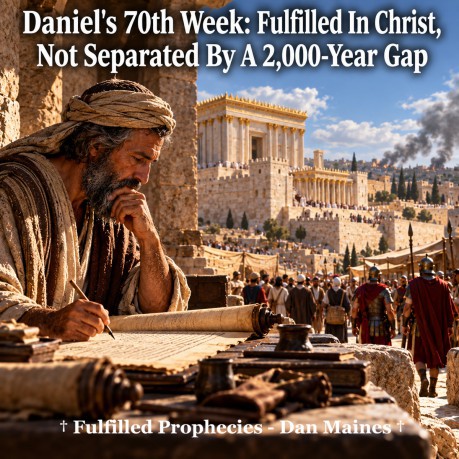
Daniel's 70th Week: Fulfilled
In Christ, Not Separated By A 2,000-Year Gap Introduction The Sabbath-Year Foundation Of Daniel's Seventy Weeks Daniel 9:24 Daniel 9:25 Luke 3:21-23 Daniel 9:26 Daniel 9:27 Matthew 26:27-28 Hebrews 9:11-12 Hebrews 10:11-14 Matthew 27:50-51 Acts 2:36-39 Acts 6:7 Acts 7:54-60 Galatians 3:16-17 Why There Is No 2,000-Year Gap Historical References How It Applies To Us Today Q & A Appendix † This is the fulfilled perspective we proclaim at
Fulfilled Prophecies †
By Dan Maines
† Daniel's
prophecy of the seventy weeks is one continuous prophecy concerning
Daniel's people, Jerusalem, the Messiah, the ending of sin's
covenantal dominion, and the establishment of everlasting
righteousness. Nothing in Daniel 9 says that God's prophetic clock
would stop after the sixty-ninth week and resume more than 2,000
years later.
† The seventy weeks were decreed
as one complete period. Gabriel didn't tell Daniel that sixty-nine
weeks belonged together while the final week would be removed and
transferred thousands of years into the future.
†
The 70th week centers on Jesus Christ. His ministry, His death, the
confirmation of God's covenant promises, and the gospel's
first-century mission to Israel provide the natural fulfillment of
Daniel's final week.
† The common calculation
beginning with the decree associated with Artaxerxes in 457 BC places
the completion of the sixty-nine weeks around AD 27, the period when
Jesus was baptized and began His public ministry. The final seven
then runs approximately from AD 27 to AD 34, with Christ's death
occurring in the middle of that period.
†
Scripture doesn't explicitly date Stephen's death to AD 34, so that
date shouldn't be treated as though a verse gives it. It is a
commonly reconstructed chronology. The important biblical point is
that Daniel's 70th week belongs to the first-century work of Christ
and the gospel mission surrounding His ministry, death, resurrection,
and the early church, not to a future seven-year tribulation
separated from the first sixty-nine weeks by thousands of years.
†
To understand why Gabriel spoke of seventy sevens, we first need to
go back to the Law. Long before Daniel received this prophecy, God
had already established a pattern of seven-year Sabbath cycles, and
Israel's failure to keep those Sabbaths was directly connected with
the exile that Daniel was praying about. That background helps
explain why Gabriel's answer came in seventy sevens and why those
sevens should be understood as a continuous prophetic timetable
(Leviticus 25:2-10; Leviticus 26:34-35; 2 Chronicles 36:20-21; Daniel
9:2).
†
Daniel's seventy weeks didn't introduce the idea of counting time in
groups of seven. God had already established that pattern in the Law.
Israel was commanded to count seven-year Sabbath cycles, and seven
cycles of seven years produced forty-nine years leading to the
Jubilee (Leviticus 25:2-10).
† This
background is important because Daniel was praying about Israel's
exile when Gabriel revealed the seventy weeks. Israel's failure to
keep God's Sabbath requirements was directly connected with the land
enjoying its Sabbaths during Israel's exile (Leviticus 26:34-35; 2
Chronicles 36:20-21).
† Jeremiah had
prophesied seventy years of Babylonian domination, and Daniel
specifically tells us that he was studying Jeremiah's seventy years
when he prayed and received the prophecy of the seventy weeks
(Jeremiah 25:11-12; Daniel 9:2).
† Gabriel's
answer therefore expands Daniel's concern from seventy years to
seventy sevens. The language naturally belongs to the covenantal
pattern of sabbatical sevens already established in Israel's Law.
†
Leviticus 25 commanded Israel to count seven Sabbaths of years, seven
times seven years, totaling forty-nine years. Daniel 9 likewise
counts units of seven as part of a divinely determined timetable
(Leviticus 25:8; Daniel 9:24-27).
† This
makes the proposed 2,000-year gap even more difficult to establish
from the text. When God established Sabbath-year cycles, the sevens
were actual consecutive units of the appointed period. Daniel gives
no statement telling us to stop counting after sixty-nine weeks and
wait thousands of years before counting the seventieth.
†
Messiah was cut off within the prophetic sequence, not after a
prophetic clock had been suspended for thousands of years. Daniel
says that after the sixty-two weeks Messiah would be cut off, and
Daniel 9:27 describes the events associated with the final week.
†
The destruction of Jerusalem and the sanctuary must be distinguished
from the completion of the 70th week itself. Daniel foretold the
destruction following Messiah's being cut off, and Jesus later
identified Jerusalem's desolation as an approaching judgment upon His
own generation (Matthew 23:36-38; Luke 21:20-22).
†
The temple's destruction in AD 70 therefore doesn't require extending
the 70th week to AD 70. The redemptive timetable centered on Messiah
could reach its completion earlier, while the covenantal judgment
announced within the prophecy came afterward in AD 70.
†
The pattern is consistent from the Law through Daniel: God
established the sevens, Israel violated the covenant, exile followed,
Daniel prayed concerning the seventy years, and Gabriel answered with
seventy sevens culminating in Messiah and the events that followed
Him. There is no stated 2,000-year interruption anywhere in that
sequence.
Seventy weeks have been decreed
for your people and your holy city, to finish the wrongdoing, to make
an end of sin, to make atonement for guilt, to bring in everlasting
righteousness, to seal up vision and prophecy, and to anoint the Most
Holy Place.
† Gabriel identified the subjects
of the prophecy: Daniel's people and Daniel's holy city. The prophecy
concerned Israel and Jerusalem and the completion of God's redemptive
purposes associated with them.
† The six
objectives point directly toward the work of Christ. Jesus came to
deal with sin, accomplish redemption, establish righteousness, and
fulfill what had been promised through the Law and the Prophets
(Matthew 5:17; Luke 24:44).
† Paul said that
Christ was publicly displayed as the means of reconciliation through
His blood, demonstrating God's righteousness (Romans 3:24-26). The
writer of Hebrews likewise connects Christ's sacrifice with putting
away sin (Hebrews 9:26).
† Daniel didn't say
that sixty-nine weeks were decreed upon Daniel's people and city
while the seventieth week belonged to an entirely different people
thousands of years later. All seventy weeks belong to the same
prophetic period.
So you are to know and
understand that from the issuing of a decree to restore and rebuild
Jerusalem, until Messiah the Prince, there will be seven weeks and
sixty-two weeks; it will be built again, with streets and moat, even
in times of distress.
† Gabriel gave Daniel a
measurable period leading to the Messiah. Seven weeks followed by
sixty-two weeks equals sixty-nine weeks, or 483 prophetic years when
the weeks are understood as groups of seven years.
†
Using the decree connected with Artaxerxes in 457 BC as the starting
point brings the sixty-nine weeks to approximately AD 27, when Jesus
entered His public ministry.
† Luke
deliberately placed the beginning of John's ministry and Jesus'
baptism within identifiable first-century history, during the reign
of Tiberius Caesar (Luke 3:1-3, 21-23).
† The
prophecy was designed to identify the arrival of the Messiah, not to
create an unexplained prophetic gap immediately before the week in
which His redemptive work would reach its climax.
Now when all the people were
baptized, Jesus also was baptized, and while He was praying, heaven
was opened, and the Holy Spirit descended upon Him in bodily form
like a dove, and a voice came from heaven: "You are My beloved
Son, in You I am well pleased." When He began His ministry,
Jesus Himself was about thirty years old, being, as was commonly
held, the son of Joseph, the son of Eli,
†
Jesus' baptism marked the beginning of His public ministry. He was
anointed by the Holy Spirit and publicly identified as God's Son.
†
Peter later summarized this beginning by speaking of Jesus of
Nazareth being anointed with the Holy Spirit and power (Acts
10:37-38).
† This fits Daniel's movement from
the decree to the appearance of Messiah the Prince. The prophetic
countdown brought history to Christ, not to a future antichrist.
Then after the sixty-two weeks,
the Messiah will be cut off and have nothing, and the people of the
prince who is to come will destroy the city and the sanctuary. And
its end will come with a flood; even to the end there will be war;
desolations are determined.
† Daniel
explicitly said that after the sixty-two weeks that followed the
first seven, the Messiah would be cut off. Jesus' death therefore
belongs immediately within the prophetic sequence following the
sixty-nine weeks.
† Isaiah had already
described the suffering Servant as being cut off out of the land of
the living (Isaiah 53:8). Daniel uses the same basic picture, the
Messiah would be removed through death.
† The
prophecy then moves toward the destruction of the city and sanctuary.
Jesus also connected Jerusalem and its temple with an approaching
first-century destruction (Matthew 23:36-38; Matthew 24:1-2).
†
Rome destroyed Jerusalem and the temple in AD 70. That historical
judgment didn't require moving Daniel's 70th week into the distant
future. Daniel's prophecy moves from Messiah's redemptive work to the
consequences that would later fall upon the city that rejected Him.
And he will confirm a covenant
with the many for one week, but in the middle of the week he will put
a stop to sacrifice and grain offering; and on the wing of
abominations will come the one who makes desolate, until a complete
destruction, one that is decreed, gushes forth on the one who makes
desolate.
† The central figure of Daniel's
prophecy is the Messiah. The covenant language fits Christ's mission
and the promises of God fulfilled through Him. Jesus said that His
blood was the blood of the covenant poured out for many (Matthew
26:28).
† Isaiah likewise described the
Servant as one who would justify the many and bear their iniquities
(Isaiah 53:11-12). Daniel's reference to the many fits this messianic
covenant setting naturally.
† In the middle
of the final week, Christ's sacrifice brought the sacrificial system
to its intended fulfillment. Animal sacrifices continued physically
until the temple's destruction, but their covenantal purpose had been
fulfilled by the once-for-all sacrifice of Christ (Hebrews 9:11-12;
Hebrews 10:10-14).
† Daniel didn't say that
sacrifice would cease because a future antichrist would interrupt a
rebuilt temple. The New Testament points us to Jesus, whose sacrifice
made the old sacrificial system obsolete.
†
If the final week began around AD 27, its midpoint falls
approximately three and a half years later, corresponding with the
period traditionally associated with Jesus' crucifixion. The
remaining portion of the week belongs naturally to the apostolic
gospel mission in the years immediately following the cross.
And when He had taken a cup
and given thanks, He gave it to them, saying, Drink from it, all of
you; for this is My blood of the covenant, which is being poured out
for many for forgiveness of sins.
† Jesus
Himself used the language that explains Daniel 9. His blood
established the covenant and was poured out for many.
†
Daniel spoke of confirming a covenant with many. Jesus spoke of His
covenant blood being poured out for many. That connection shouldn't
be ignored in favor of inserting a future antichrist into a passage
centered on Messiah.
† The cross wasn't an
interruption of Daniel's prophecy. The cross was at the heart of its
fulfillment.
But when Christ appeared as
a high priest of the good things having come, He entered through the
greater and more perfect tabernacle, not made by hands, that is, not
of this creation; and not through the blood of goats and calves, but
through His own blood, He entered the holy place once for all time,
having obtained eternal redemption.
† Christ
accomplished what the old sacrifices could never accomplish. He
entered through His own blood and obtained eternal redemption.
†
This explains how sacrifice and offering reached their covenantal
end. Their physical continuation couldn't give them continuing
redemptive authority after Jesus offered the perfect sacrifice.
†
Once the substance arrived, the shadows had fulfilled their purpose
(Colossians 2:16-17). The temple sacrifices continued for a
transitional period, but before God they had been surpassed
permanently by Christ.
Every priest stands daily
ministering and offering time after time the same sacrifices, which
can never take away sins; but He, having offered one sacrifice for
sins for all time, sat down at the right hand of God, waiting from
that time onward until His enemies are made a footstool for His feet.
For by one offering He has perfected for all time those who are
sanctified.
† Daniel's statement about
sacrifice and offering finds its redemptive explanation in Christ's
one sacrifice.
† The old priests repeatedly
offered sacrifices because those sacrifices could never remove sins.
Jesus offered one sacrifice that accomplished what the entire old
system couldn't accomplish.
† The issue
wasn't the exact day when Jewish priests stopped killing animals. The
issue was when those sacrifices lost their covenantal standing before
God. Christ's perfect sacrifice accomplished that at the cross.
And Jesus cried out again
with a loud voice, and gave up His spirit. And behold, the veil of
the temple was torn in two from top to bottom; and the earth shook
and the rocks were split.
† The tearing of
the temple veil at Christ's death visibly demonstrated a decisive
covenantal change. God Himself opened the way that the old sanctuary
had symbolized.
† The temple remained
standing until AD 70, but its covenantal function had reached its
fulfillment in Christ. The physical structure continued during the
transition, just as sacrifices continued, but the reality to which
those shadows pointed had arrived.
† This is
why the middle of Daniel's final week belongs at the cross. Messiah
was cut off, His blood established the covenant, and His sacrifice
fulfilled the old sacrificial system.
Therefore let all the house of
Israel know for certain that God has made Him both Lord and
Christ-this Jesus whom you crucified." Now when they heard
this, they were pierced to the heart, and said to Peter and the rest
of the apostles, "Brothers, what are we to do?" Peter said
to them, "Repent, and each of you be baptized in the name of
Jesus Christ for the forgiveness of your sins; and you will receive
the gift of the Holy Spirit. For the promise is for you and your
children and for all who are far away, as many as the Lord our God
will call to Himself."
† After the
cross and resurrection, the covenant message continued to be
proclaimed directly to Israel. Peter addressed the house of Israel
and announced that the crucified Jesus was both Lord and Christ.
†
Peter said the promise was for them and their children. This
continued focus on Israel fits naturally within the remaining portion
of Daniel's final week.
† Thousands of
Israelites responded to the gospel during this period (Acts 2:41;
Acts 4:4). The Messiah had been cut off, but God's promised message
continued going out to Daniel's people.
The word of God kept spreading; and
the number of the disciples continued to increase greatly in
Jerusalem, and a great many of the priests were becoming obedient to
the faith.
† Notice where the gospel was
flourishing, Jerusalem. Even priests were becoming obedient to the
faith.
† This wasn't a prophetic clock
sitting motionless while God waited thousands of years to finish
Daniel's final seven. The events Daniel foretold were unfolding
around Jerusalem, the Messiah, the covenant, sacrifice, and Daniel's
people.
† The early chapters of Acts
therefore provide a natural continuation of the covenant mission
begun by Jesus.
Now when they heard this, they
were infuriated, and they began gnashing their teeth at him. But he,
being full of the Holy Spirit, looked intently into heaven and saw
the glory of God, and Jesus standing at the right hand of God; and he
said, "Behold, I see the heavens opened and the Son of Man
standing at the right hand of God." But they shouted with loud
voices, and covered their ears and rushed at him with one mind. When
they had driven him out of the city, they began stoning him; and the
witnesses laid aside their cloaks at the feet of a young man named
Saul. They went on stoning Stephen as he called on the Lord and said,
"Lord Jesus, receive my spirit!" Then he fell on his knees
and cried out with a loud voice, "Lord, do not hold this sin
against them!" Having said this, he fell asleep.
†
Stephen's death provides an important historical marker in the early
church's mission to Israel. His speech reviewed Israel's history and
confronted Jerusalem's leadership with its resistance to God's
messengers and ultimately to Christ.
†
Shortly afterward, persecution scattered believers beyond Jerusalem,
and the book of Acts increasingly records the gospel moving outward
(Acts 8:1-5; Acts 10:34-48; Acts 13:46-48).
†
Many chronologies place Stephen's martyrdom around AD 34, which would
correspond approximately with the completion of a seven-year period
beginning around AD 27. Scripture itself doesn't provide the calendar
year of Stephen's death, so this chronological connection should be
presented as a historical reconstruction rather than an explicitly
dated biblical statement.
† What Scripture
does establish is that Jesus' ministry, death, resurrection, and the
earliest apostolic mission to Israel all belong together in the same
first-century setting described by Daniel's prophecy.
Now the promises were
spoken to Abraham and to his seed. He does not say, "And to
seeds," as one would in referring to many, but rather as in
referring to one, "And to your seed," that is, Christ. What
I am saying is this: the Law, which came 430 years later, does not
invalidate a covenant previously ratified by God, so as to nullify
the promise.
† The New Testament consistently
places covenant fulfillment in Christ. He is the promised Seed
through whom God's promises reach their fulfillment.
†
This makes Christ the natural focus of Daniel 9:27. Reading the
covenant of Daniel's final week through Christ agrees with the New
Testament's covenant theology.
† Moving
Daniel 9:27 away from Christ and making a future antichrist its
central covenant figure requires assumptions that Daniel never
states.
†
Daniel 9:24 says seventy weeks were decreed. It doesn't say
sixty-nine weeks were decreed followed by an indefinite interruption
and then one final week thousands of years later.
†
The sequence is continuous: seven weeks, sixty-two weeks, then the
events involving Messiah and the final week. Nothing in the text
announces that the seventieth week has been detached from the first
sixty-nine.
† If someone inserted a
2,000-year gap between the sixty-ninth and seventieth units of
another biblical time prophecy, the text itself would need to
establish that interruption. Daniel 9 doesn't establish one.
†
Jesus, not a future antichrist, dominates the prophecy. Messiah
appears, Messiah is cut off, covenant promises are fulfilled,
sacrifice reaches its fulfillment, and afterward Jerusalem and the
sanctuary face the determined desolation.
†
Once the 70th week is allowed to remain where Gabriel placed it,
immediately following the sixty-nine weeks, the prophecy points
directly into the ministry of Jesus and the first-century transition
from the old covenant order to its fulfillment in Christ.
†
Josephus described the catastrophic Roman war, the siege of
Jerusalem, the destruction of the temple, and the devastation that
followed. His account provides an important non-Christian historical
witness to the first-century destruction associated with the city and
sanctuary in Daniel's prophecy.
† Josephus
wrote extensively about the conditions surrounding Jerusalem's fall,
including famine, internal conflict, Roman siege operations, and the
temple's destruction in AD 70. These events correspond historically
with Jesus' warnings concerning Jerusalem's approaching desolation
(Matthew 24:1-2; Luke 21:20-24).
† Eusebius
later recorded the early Christian understanding that believers in
Jerusalem left the city before the war and went to Pella. His account
reflects the early connection between Jesus' warnings and the
first-century judgment that came upon Jerusalem.
†
These historical witnesses don't establish the interpretation by
themselves. Scripture establishes the prophetic framework, while
history confirms that Jerusalem and its sanctuary experienced the
first-century destruction Daniel and Jesus described.
†
We don't need to wait for Daniel's 70th week to begin. Its focus was
Christ and His first-century redemptive work.
†
We don't need a rebuilt temple, restored animal sacrifices, or a
future seven-year interruption of sacrifices to complete Daniel 9.
Jesus already offered the sacrifice that could never be repeated or
improved upon (Hebrews 10:10-14).
† We
shouldn't move the covenant away from Jesus and give its central role
to a future antichrist when Jesus explicitly identified His own blood
as the blood of the covenant poured out for many (Matthew 26:28).
†
Understanding Daniel's 70th week removes one of the major foundations
supporting a future seven-year tribulation scheme. Daniel's seventy
weeks lead us to Christ, His cross, His covenant, and the
first-century judgment upon Jerusalem.
† The
prophecy isn't primarily about our future. It's about God's
faithfulness in keeping His promises through Jesus Christ.
†
When Daniel 9 is allowed to remain in its historical and covenantal
setting, the pieces fit together without inserting a 2,000-year gap
that Gabriel never mentioned.
Q: Does
Daniel 9 actually say there is a gap between the sixty-ninth and
seventieth weeks?
A: No. Daniel presents
seventy weeks as the complete period decreed concerning Daniel's
people and holy city. The text doesn't state that the final week
would be separated from the preceding sixty-nine by thousands of
years (Daniel 9:24-27).
Q: Who is the central
figure of Daniel's 70th week?
A: The prophecy's
focus is the Messiah. He appears after the sixty-nine weeks, is cut
off, and the covenant and sacrificial language fits the New
Testament's description of Christ's work (Matthew 26:28; Hebrews
9:11-12).
Q: Did Jesus cause sacrifices to
cease physically at the cross?
A: The priests
continued offering animals until the temple was destroyed, but
Christ's one sacrifice brought their covenantal purpose to
fulfillment. His sacrifice accomplished permanently what animal
sacrifices could never accomplish (Hebrews 10:11-14).
Q:
Does Daniel 9:27 identify the one confirming the covenant as the
antichrist?
A: Daniel 9:27 doesn't use the word
antichrist. The immediate prophecy concerns the Messiah, and Jesus
specifically described His blood as covenant blood poured out for
many (Matthew 26:28).
Q: Was Stephen definitely
stoned in AD 34?
A: Scripture doesn't give a
calendar year for Stephen's death. AD 34 is a chronological
reconstruction used by many interpreters. Stephen's martyrdom can
serve as an approximate marker near the end of the period, but we
shouldn't claim that Scripture explicitly dates it to AD 34 (Acts
7:54-60).
Q: What happened after Stephen's
death?
A: Persecution scattered believers from
Jerusalem, and the gospel increasingly moved beyond Jerusalem and
Judea toward Samaria and the nations (Acts 8:1-5; Acts 10:34-48; Acts
13:46-48).
Q: What is the biggest problem with
inserting a 2,000-year gap?
A: Daniel never
states one. The seventy weeks are presented as the period decreed
concerning Daniel's people and Jerusalem, and the events following
the sixty-nine weeks lead directly into the Messiah's first-century
work (Daniel 9:24-27).
Q: Why does this matter
for understanding the end times?
A: If Daniel's
70th week was fulfilled in the first century, it can't serve as the
basis for moving a seven-year tribulation, restored temple
sacrifices, and Daniel's final week into our future. Jesus placed
Jerusalem's coming judgment within the generation then living
(Matthew 23:36; Matthew 24:34).
© Fulfilled Prophecies - Dan
Maines.
Source Index
†
Leviticus 25:2-10; Leviticus 26:34-35; 2 Chronicles 36:20-21;
Jeremiah 25:11-12; Daniel 9:2; Daniel 9:24; Daniel 9:25; Luke
3:21-23; Daniel 9:26; Daniel 9:27; Matthew 26:27-28; Hebrews 9:11-12;
Hebrews 10:11-14; Matthew 27:50-51; Acts 2:36-39; Acts 6:7; Acts
7:54-60; Galatians 3:16-17
† Historical
writers: Flavius Josephus, The Wars of the Jews; Eusebius,
Ecclesiastical History
Links