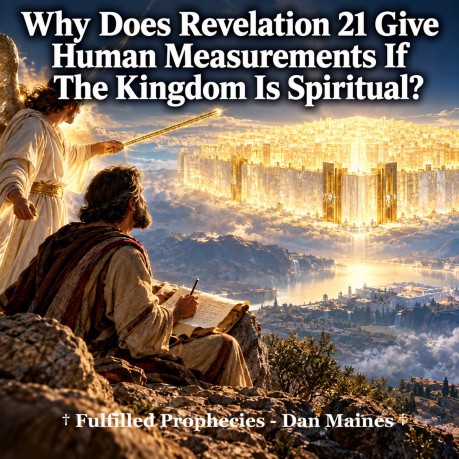
Why Does Revelation 21 Give
Human Measurements If The Kingdom Is Spiritual? Introduction Revelation 21:9-10 Revelation 21:15-17 Revelation 21:12-14 Revelation 21:22-23 Revelation 21:2-3 Hebrews 12:22-24 Galatians 4:25-26 Revelation 11:1-2 Ephesians 2:19-22 Historical References How It Applies To Us Today Q & A Appendix Q: Why does Revelation 21:17 specifically call it
a human measurement? Q: Why is the city shaped with equal length,
width, and height? Q: Doesn't a wall of 144 cubits require a literal
wall? Q: Are Christians living in New Jerusalem now? Q: What is the strongest evidence that New
Jerusalem isn't merely a future physical city? † This is the fulfilled perspective we proclaim at
Fulfilled Prophecies †
By Dan Maines
† Revelation
21 describes the New Jerusalem with walls, gates, foundations,
precious stones, and enormous measurements. Because the city is
measured, some assume John must be describing a future physical city
that will literally descend from the sky.
†
But Revelation itself identifies the city before giving its
measurements. John isn't shown a construction project. He's shown the
bride, the wife of the Lamb, under the imagery of a magnificent city
(Revelation 21:2, 9-10).
† The measurements
don't turn the spiritual kingdom into a physical city any more than
twelve gates of pearl require Christians to enter the kingdom through
literal pearls. Revelation uses visible, measurable symbols to
communicate spiritual and covenant realities.
†
The key isn't asking whether the numbers are real numbers. The key is
asking what John says is being measured and how Revelation itself
interprets the imagery.
Then one of the seven
angels who had the seven bowls, full of the seven last plagues, came
and spoke with me, saying, "Come here, I will show you the
bride, the wife of the Lamb." And he carried me away in the
Spirit to a great and high mountain, and showed me the holy city,
Jerusalem, coming down out of heaven from God,
†
The angel promises to show John the bride, the wife of the Lamb, and
then shows him the holy city. Revelation interprets its own symbol
before the measurements are even given.
†
John isn't told, I'll show you where the bride will live. He's told
that he'll be shown the bride, and what he sees is New Jerusalem.
†
The city represents God's covenant people in union with Christ. Paul
likewise described the church as being prepared for Christ as a pure
virgin (2 Corinthians 11:2), and he called the Jerusalem above our
mother (Galatians 4:26).
The one who spoke with
me had a gold measuring rod to measure the city, its gates, and its
wall. The city is laid out as a square, and its length is as great as
the width; and he measured the city with the rod, twelve thousand
stadia; its length, width, and height are equal. And he measured its
wall, 144 cubits, by human measurements, which are also angelic
measurements.
† John explicitly says the
measurement is according to human measurement, which the angel was
using. Human units make the vision understandable to human readers,
but they don't require the object represented by the vision to be
physically constructed.
† The numbers
themselves point toward covenant symbolism. Twelve thousand and one
hundred forty-four are built around twelve, the number repeatedly
associated in Revelation 21 with God's covenant people.
†
The city has twelve gates associated with the twelve tribes and
twelve foundations associated with the twelve apostles (Revelation
21:12-14). The measurements belong to that same symbolic pattern.
†
A city whose length, width, and height are equal also recalls the
shape of the Most Holy Place, which was measured equally in its
dimensions (1 Kings 6:20). John's city portrays the presence of God
extending throughout the entire covenant community.
It had a great and high
wall, with twelve gates, and at the gates twelve angels; and names
were written on the gates, which are the names of the twelve tribes
of the sons of Israel. There were three gates on the east, three
gates on the north, three gates on the south, and three gates on the
west. And the wall of the city had twelve foundation stones, and on
them were the twelve names of the twelve apostles of the Lamb.
†
The city is covered with covenant identity. The tribes are written on
its gates, and the apostles are written on its foundations.
†
These aren't architectural details given merely to help someone build
a future city. They identify the people represented by the city.
†
Paul used similar building imagery when he said believers were God's
household, built on the foundation of the apostles and prophets, with
Christ Jesus Himself as the cornerstone (Ephesians 2:19-22).
†
Revelation's twelve gates and twelve foundations present the
completed covenant people of God, not two unrelated peoples and not a
future return to the Old Covenant.
I saw no temple in it,
for the Lord God the Almighty and the Lamb are its temple. And the
city has no need of the sun or of the moon to shine on it, for the
glory of God has illuminated it, and its lamp is the Lamb.
†
This is one of the clearest reasons not to force Revelation 21 into
wooden literalism. John sees a city, but there isn't a temple
building inside it because God and the Lamb are its temple.
†
If every architectural feature must be physically literal because
John gives measurements, consistency would also require a literal
city that has no need of the physical sun or moon for its light.
†
John's emphasis is God's presence. What the Jerusalem temple
represented through physical architecture has reached its covenant
reality in God dwelling with His people (Revelation 21:3).
†
The New Covenant temple isn't a building made from stone. God's
people are His dwelling through the Spirit (Ephesians 2:21-22).
And I saw the holy city,
new Jerusalem, coming down out of heaven from God, prepared as a
bride adorned for her husband. And I heard a loud voice from the
throne, saying, Behold, the tabernacle of God is among the people,
and He will dwell among them, and they shall be His people, and God
Himself will be among them,
† The city comes
down from heaven. The movement isn't redeemed humanity leaving earth
for a distant celestial city. The picture is God's dwelling coming to
humanity.
† John immediately explains the
significance, God's dwelling is with mankind. The emphasis is
covenant presence, not geographical relocation.
†
The bride imagery confirms the identity of the city. A bride adorned
for her husband is personal and covenantal imagery, not a description
of literal masonry.
† The promise reaches
back through Scripture to God's repeated purpose of dwelling among
His people (Leviticus 26:11-12; Ezekiel 37:27).
But you have come to Mount
Zion and to the city of the living God, the heavenly Jerusalem, and
to myriads of angels, to the general assembly and church of the
firstborn who are enrolled in heaven, and to God, the Judge of all,
and to the spirits of the righteous made perfect, and to Jesus, the
mediator of a new covenant, and to the sprinkled blood, which speaks
better than the blood of Abel.
† The writer
didn't tell his first-century Christian readers that heavenly
Jerusalem was thousands of years away. He told them they had come to
Mount Zion and the heavenly Jerusalem.
† This
Jerusalem is directly connected with the assembly, the New Covenant,
Jesus the mediator, and access to God.
†
Revelation 21 shows the completed form of the same covenant reality
Hebrews describes. The earthly Jerusalem belonged to the order that
was passing away, while the heavenly Jerusalem belonged to the
kingdom that couldn't be shaken (Hebrews 12:26-28).
Now this Hagar is Mount
Sinai in Arabia and corresponds to the present Jerusalem, for she is
enslaved with her children. But the Jerusalem above is free; she is
our mother.
† Paul establishes a covenant
contrast between two Jerusalems. The Jerusalem of his day
corresponded to slavery, while the Jerusalem above was free.
†
Paul didn't describe the Jerusalem above as a future physical
metropolis. He identified it with the free covenant community.
†
Revelation's New Jerusalem develops this same contrast. The old city
faced covenant judgment, while the heavenly Jerusalem represents the
bride living in the freedom and presence of the New Covenant.
Then there was given to me
a measuring rod like a staff; and someone said, Get up and measure
the temple of God and the altar, and those who worship in it. Leave
out the courtyard which is outside the temple and do not measure it,
because it has been given to the nations; and they will trample the
holy city for forty-two months.
† Revelation
had already used measurement symbolically before chapter 21. John
wasn't merely measuring architecture. He was told to measure the
temple, the altar, and those who worship there.
†
People can't literally be measured as architectural structures. The
act of measuring communicates divine ownership, identification,
preservation, and determined boundaries.
†
That provides an important interpretive precedent for Revelation 21.
Measuring the New Jerusalem signifies the completeness and perfection
of what God established.
† The same book that
measures worshipers in chapter 11 measures the bride-city in chapter
21. Neither passage requires the kingdom itself to be physical.
So then you are no longer
strangers and foreigners, but you are fellow citizens with the
saints, and are of God's household, having been built on the
foundation of the apostles and prophets, Christ Jesus Himself being
the cornerstone, in whom the whole building, being fitted together,
is growing into a holy temple in the Lord, in whom you also are being
built together into a dwelling of God in the Spirit.
†
Paul uses architectural language for living people. Christians are
fellow citizens, God's household, a building, a holy temple, and
God's dwelling in the Spirit.
† No one needs
to conclude that believers physically become bricks because Paul says
they're being built together. The architecture communicates spiritual
reality.
† Revelation uses the same biblical
language on a grand scale. The bride becomes a city because the city
represents the completed dwelling place of God with His covenant
people.
† Human measurements don't make that
spiritual dwelling physical. They give visible form to its order,
perfection, completeness, security, and covenant identity.
†
Josephus described first-century Jerusalem and its temple in
extensive physical detail, including walls, courts, gates,
dimensions, and precious materials. His descriptions help demonstrate
how naturally John's first-century audience would've understood
temple and city imagery against the world they knew.
†
Josephus also recorded the catastrophic destruction of Jerusalem and
the temple by the Romans in AD 70. That historical setting provides
an important background for Revelation's contrast between the judged
city and the New Jerusalem.
† Eusebius later
recorded the tradition that believers in Jerusalem departed before
the war and described the disasters that overtook the city. His
account reflects the early Christian memory of Jerusalem's
first-century judgment.
† These historical
writers don't determine the meaning of Revelation, Scripture does.
Their value is in confirming the first-century historical world in
which Revelation's Jerusalem imagery would've been understood.
†
We don't need to wait for a gigantic cube-shaped city to descend from
outer space before we can belong to New Jerusalem. In Christ, we've
come to the heavenly Jerusalem and belong to God's household (Hebrews
12:22; Ephesians 2:19).
† The glory of
Revelation 21 isn't the size of its walls. It's the reality those
walls communicate, God's completed covenant dwelling with His
people.
† The measurements communicate
completeness, order, security, and perfection. Nothing is missing
from what Christ accomplished.
† We aren't
waiting for God to move into a future building. Through Christ,
believers are already being built together as God's dwelling in the
Spirit (Ephesians 2:22).
† Revelation 21
gives human measurements because revelation communicates heavenly
realities through symbols humans can understand. The measurements
serve the symbol, they don't overturn Revelation's own identification
of the city as the bride.
† The question is
settled by John's own explanation. The angel said he would show John
the bride, and he showed him New Jerusalem (Revelation 21:9-10). The
city is measured, but the city is the bride.
Q: If
Revelation 21 gives exact measurements, doesn't that prove the city
is physical?
A: No. Revelation 11:1 measures
the temple, altar, and worshipers. Measurement can symbolize God's
ownership, boundaries, order, and completeness without requiring
everything measured to be a physical structure.
A: Because the vision is
communicating through measurements humans understand. John tells us
the standard being used, but that doesn't change the identity of the
city that was already given as the bride, the wife of the Lamb
(Revelation 21:9-10).
A: The shape recalls the
Most Holy Place, whose length, width, and height were equal (1 Kings
6:20). Revelation expands that sanctuary imagery into an enormous
city because God's presence is no longer pictured as confined to one
inner room.
A: Not when the surrounding imagery is
symbolic. The wall belongs to a city with twelve apostolic
foundations, twelve tribal gates, pearl gates, and God and the Lamb
as its temple (Revelation 21:12-14, 21-22). The imagery communicates
covenant reality.
A:
Yes. Hebrews says believers have come to Mount Zion and the heavenly
Jerusalem (Hebrews 12:22), and Paul says the Jerusalem above is our
mother (Galatians 4:26). Revelation portrays that New Covenant
reality in its completed and victorious form.
A:
Revelation identifies it directly. The angel promises to show John
the bride, the wife of the Lamb, and then shows him the holy city,
Jerusalem (Revelation 21:9-10). We should allow John's inspired
identification to interpret John's inspired imagery.
© Fulfilled Prophecies - Dan
Maines.
Source Index
†
Revelation 21:9-10; Revelation 21:15-17; Revelation 21:12-14;
Revelation 21:22-23; Revelation 21:2-3; Hebrews 12:22-24; Galatians
4:25-26; Revelation 11:1-2; Ephesians 2:19-22
†
Historical writers: Josephus, The Jewish War; Eusebius,
Ecclesiastical History
Links