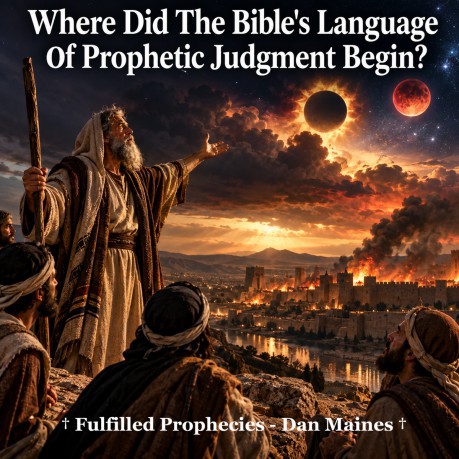
Where Did The Bible's
Language Of Prophetic Judgment Begin? Introduction Genesis 1:14-18 Genesis 37:9-10 Deuteronomy 32:22-23 Isaiah 13:9-10 Ezekiel 32:7-8 Isaiah 34:4-5 Joel 2:30-31 Matthew 24:29-30 Revelation 6:12-14 Historical References How It Applies To Us Today Q & A Appendix Q: Does Genesis 1:14 prove that every later
reference to the sun, moon, and stars is symbolic? Q: Why is Joseph's dream especially important? Q: Why did the prophets describe national
judgment with cosmic language? Q: Does that help explain Jesus' language in
Matthew 24? Q: Does Revelation invent a new system of
prophetic symbolism? Q: Where, then, does the Bible's standard for
prophetic judgment imagery ultimately begin? † This is the fulfilled perspective we proclaim at
Fulfilled Prophecies † Source Index
By Dan Maines
† The
Bible's language of prophetic judgment didn't suddenly appear when
the prophets announced judgment against Egypt, Babylon, Edom, or
Jerusalem. Its foundations reach much deeper into Scripture.
†
Before Isaiah described stars disappearing, the sun becoming dark,
and the heavens being shaken, Genesis had already established the
sun, moon, and stars as God's appointed rulers, signs, and markers in
the created order (Genesis 1:14-18).
†
Joseph's dream then shows the sun, moon, and stars representing human
rulers and a covenant family. Jacob himself interpreted the imagery
as referring to Jacob, Rachel, and Joseph's brothers (Genesis
37:9-10).
† Later prophets didn't invent a
new symbolic vocabulary. They drew upon patterns already established
in Scripture and applied creation language to kingdoms, rulers,
covenant communities, and divine judgment.
†
This means the prophetic language of the Old Testament has roots
reaching back through Joseph's dreams and ultimately into the
creation account itself.
Then God said, "Let
there be lights in the expanse of the heavens to separate the day
from the night, and they shall serve as signs and for seasons, and
for days and years; and they shall serve as lights in the expanse of
the heavens to give light on the earth"; and it was so. God made
the two great lights, the greater light to govern the day, and the
lesser light to govern the night; He made the stars also. God placed
them in the expanse of the heavens to give light on the earth, and to
govern the day and the night, and to separate the light from the
darkness; and God saw that it was good.
†
This is one of the earliest foundations for understanding later
prophetic imagery. The heavenly lights were created not only to give
light, but also for signs and appointed times.
†
Notice the language of rule. The greater light rules the day, and the
lesser light rules the night. Scripture therefore introduces heavenly
bodies together with the concept of governing authority.
†
Later prophetic passages can use the disruption of these heavenly
rulers as symbolic language for the overthrow of earthly rulers and
established orders because Scripture itself had already connected the
heavenly lights with rule (Psalm 136:7-9).
†
This doesn't mean every reference to the sun, moon, or stars is
symbolic. Context determines meaning. It does mean that the symbolic
vocabulary used later by the prophets has roots extending back to
creation itself.
Then he had yet another
dream, and informed his brothers of it, and said, "Behold, I
have had yet another dream; and behold, the sun and the moon, and
eleven stars were bowing down to me." He also told it to his
father as well as to his brothers; and his father rebuked him and
said to him, "What is this dream that you have had? Am I and
your mother and your brothers actually going to come to bow down to
the ground before you?"
† Here Scripture
interprets its own symbolism. Joseph saw a sun, a moon, and eleven
stars, but Jacob understood that the vision concerned people.
†
Jacob identified the imagery with himself, Joseph's mother, and
Joseph's brothers. The heavenly bodies represented the covenant
family rather than a prediction that astronomical objects would
literally bow down.
† This passage is
extremely important because the interpretation isn't being imposed
centuries later. The symbolic meaning is given within the narrative
itself.
† By the time the prophets later used
sun, moon, stars, and heavens in prophetic visions, Scripture already
had an established example of heavenly imagery representing earthly
and covenant realities.
For a fire has flared
in My anger, And it burns to the lowest part of Sheol, And devours
the earth with its yield, And sets on fire the foundations of the
mountains. I will add misfortunes to them; I will use up My arrows
on them.
† Moses used creation-sized language
while describing covenant judgment upon Israel. God's anger burns,
consumes the land, and sets the foundations of the mountains on
fire.
† This provides an important bridge
between Genesis and the later prophets. Cosmic and creation imagery
became part of the covenant vocabulary of judgment.
†
The language doesn't require the physical planet to be destroyed. The
song itself concerns God's covenant dealings with His people and the
judgments that would come upon them because of their unfaithfulness
(Deuteronomy 32:5-6, 19-21).
† The later
prophets inherited this vocabulary. They weren't introducing an
entirely different prophetic method.
Behold, the day of the Lord
is coming, Cruel, with fury and burning anger, To make the land a
desolation; And He will exterminate its sinners from it. For the
stars of heaven and their constellations Will not flash their light;
The sun will be dark when it rises And the moon will not shed its
light.
† Isaiah applies the established
cosmic vocabulary directly to historical judgment. The context
identifies the prophecy as an oracle concerning Babylon (Isaiah
13:1).
† The darkened sun, moon, and stars
communicate the collapse of Babylon's power, glory, rulers, and
established order under God's judgment.
†
Isaiah didn't require his readers to believe that the literal
universe had to cease existing when Babylon fell. The imagery
communicates the magnitude of God's intervention in history.
†
This becomes a major interpretive standard. When similar language
appears later in Scripture, we must first ask how Scripture has
already used that language before assuming the physical universe must
be destroyed.
And when I extinguish you, I
will cover the heavens and darken their stars; I will cover the sun
with a cloud And the moon will not give its light. All the shining
lights in the heavens I will darken over you And will set darkness on
your land, Declares the Lord God.
† Ezekiel
uses nearly the same cosmic vocabulary against Egypt and Pharaoh. The
context explicitly identifies Pharaoh king of Egypt as the object of
the lamentation (Ezekiel 32:2).
† God says
He'll cover the heavens, darken the stars, cover the sun, and prevent
the moon from giving its light. Yet the prophecy concerns the
downfall of Egypt's ruler and power.
† This
gives us another inspired example showing that cosmic darkness can
describe political and national judgment.
†
Genesis established heavenly lights as rulers and signs, Joseph's
dream demonstrated their symbolic application to human authorities,
and the prophets developed that established vocabulary when
announcing the fall of nations.
And all the heavenly lights
will wear away, And the sky will be rolled up like a scroll; All its
lights will also wither away As a leaf withers from the vine, Or as
one withers from the fig tree. For My sword has drunk its fill in
heaven; Behold it shall descend for judgment upon Edom, And upon the
people whom I have designated for destruction.
†
Here the heavens are rolled up like a scroll and their host falls,
yet Isaiah immediately identifies Edom as the object of God's
judgment.
† The imagery sounds universal when
isolated from its context, but the context identifies a historical
nation being brought under divine judgment.
†
This passage establishes another important principle. The magnitude
of prophetic imagery doesn't determine the geographical extent of the
historical event being described.
† God could
describe the collapse of a nation as the shaking or dissolution of
its heavens because prophetic language portrayed the destruction of
an established world of authority and order.
I will display wonders in the
sky and on the earth, Blood, fire, and columns of smoke. The sun
will be turned into darkness, And the moon into blood, Before the
great and awesome day of the Lord comes.
†
Joel continues the established prophetic vocabulary of cosmic
disturbance surrounding the day of the LORD.
†
Peter later quoted this passage at Pentecost and said, this is what
was spoken through the prophet Joel (Acts 2:16-21).
†
Peter therefore placed Joel's prophecy within the last-days setting
already unfolding in his own generation rather than moving its
beginning thousands of years into the future.
†
The same imagery that had described divine judgment throughout
Israel's Scriptures remained part of the prophetic vocabulary used in
the New Testament.
But immediately after the
tribulation of those days the sun will be darkened, and the moon will
not give its light, and the stars will fall from the sky, and the
powers of the heavens will be shaken. And then the sign of the Son of
Man will appear in the sky, and then all the tribes of the earth will
mourn, and they will see the Son of Man coming on the clouds of the
sky with power and great glory.
† Jesus
didn't speak in a prophetic vacuum. His language came from the
prophetic vocabulary His Jewish audience already knew from Isaiah,
Ezekiel, Joel, Daniel, and the rest of Israel's Scriptures.
†
Sun, moon, stars, shaken heavens, clouds, and judgment already had
established biblical meanings before Jesus used them in the Olivet
Discourse.
† Jesus also placed these events
within the generation standing before Him, saying that all these
things would occur before that generation passed away (Matthew
24:34).
† Reading Matthew 24 through its Old
Testament background allows Scripture to interpret Scripture instead
of forcing modern assumptions onto ancient prophetic language.
And I looked when He
broke the sixth seal, and there was a great earthquake; and the sun
became as black as sackcloth made of hair, and the whole moon became
like blood; and the stars of the sky fell to the earth, as a fig tree
drops its unripe figs when shaken by a great wind. The sky was split
apart like a scroll when it is rolled up, and every mountain and
island was removed from its place.
†
Revelation gathers together imagery already established throughout
Scripture. The darkened sun, blood-colored moon, falling stars,
rolled-up heaven, earthquake, mountains, and islands all belong to an
existing prophetic vocabulary.
† John's
imagery shouldn't be interpreted as though nobody had ever written
this way before. Isaiah had already described the heavens being
rolled up like a scroll in a prophecy concerning Edom (Isaiah
34:4-5).
† Revelation therefore stands at the
end of a long biblical symbolic tradition rather than at the
beginning of one.
† The safest way to
understand Revelation is to trace its symbols backward through the
prophets, through the covenant writings, through Joseph, and
ultimately back to the foundational patterns introduced in Genesis.
†
Josephus described signs, portents, famine, fire, warfare, and
extraordinary events surrounding Jerusalem's destruction in AD 70.
His account demonstrates how catastrophic the judgment appeared to
those who lived through it, although Josephus isn't our authority for
interpreting Scripture. Scripture remains the standard.
†
Josephus recorded a remarkable statement concerning armies and
chariots appearing among the clouds before Jerusalem's fall. Whatever
conclusion is reached about that report, it shows that first-century
writers described the period surrounding Jerusalem's destruction in
extraordinary language.
† Tacitus likewise
recorded unusual signs and portents associated with the period
surrounding Jerusalem's fall. His testimony provides independent
historical evidence for the atmosphere of catastrophe surrounding the
Jewish-Roman War.
† Eusebius later connected
Jesus' warnings with the calamities that came upon Jerusalem and
recorded the tradition that believers left the city before its
destruction.
† These historical writers don't
create our interpretation. They help illuminate the historical
setting, while the biblical foundation for prophetic symbolism comes
from Scripture itself.
†
We shouldn't begin interpreting prophetic imagery by asking what sun,
moon, stars, heavens, mountains, earthquakes, and clouds mean to a
modern reader. We should begin by asking how Scripture already used
those images.
† Genesis gives us the
foundation, Joseph provides an early inspired demonstration, Moses
develops creation language in covenant judgment, and the prophets
repeatedly apply cosmic imagery to historical nations and rulers.
†
Jesus and the writers of the New Testament inherited that same
prophetic vocabulary. They didn't abandon thousands of years of
biblical symbolism without explanation.
†
This protects us from turning every cosmic expression into a
prediction about the physical destruction of the universe.
†
It also reveals something deeper. Biblical apocalyptic language isn't
random exaggeration. It's a carefully developed vocabulary rooted in
creation, covenant, rule, judgment, and restoration.
†
When God removes a ruling order, Scripture can portray its lights
going dark. When He judges an established covenant world, its heavens
can shake. When rulers fall, its stars can fall. When an order
reaches its appointed end, its heavens can be rolled away.
†
The prophetic vocabulary that reaches its fullest expression in
Revelation didn't begin in Revelation. Its roots reach all the way
back to Genesis.
Q: Did
prophetic sun, moon, and star symbolism begin with Isaiah?
A:
No. Genesis already connected the heavenly lights with signs,
appointed times, and ruling functions, and Joseph's dream explicitly
used the sun, moon, and stars to represent people (Genesis 1:14-18;
Genesis 37:9-10).
A:
No. Context determines whether a passage is literal or symbolic.
Genesis establishes foundational concepts, while passages such as
Genesis 37:9-10 explicitly demonstrate symbolic usage.
A:
Because Scripture itself interprets the symbols. Jacob understood the
sun, moon, and eleven stars as representing members of his family
(Genesis 37:9-10). We don't have to invent the symbolism.
A: Because the
imagery communicated the collapse of rulers, powers, nations, and
established orders under God's judgment. Isaiah used it concerning
Babylon and Edom, while Ezekiel used it concerning Egypt (Isaiah
13:1, 9-10; Isaiah 34:4-5; Ezekiel 32:2, 7-8).
A: Yes. Jesus used the established
language of Israel's prophets when He described the sun being
darkened, the moon withholding its light, the stars falling, and the
powers of the heavens being shaken (Matthew 24:29-30). He then placed
all these things within that generation (Matthew 24:34).
A: No. Revelation draws
heavily from imagery already established throughout the Old
Testament. The rolled-up heaven of Revelation 6:14, for example,
echoes Isaiah's judgment language concerning Edom (Isaiah 34:4-5;
Revelation 6:12-14).
A:
Its deepest foundations reach back to creation itself. Genesis
introduces heavenly lights as signs and rulers, Joseph's dream
demonstrates their symbolic relationship to earthly people and
authority, and later Scripture develops those foundations into the
prophetic vocabulary of covenant and national judgment (Genesis
1:14-18; Genesis 37:9-10).
© Fulfilled Prophecies - Dan
Maines.
† Genesis
1:14-18; Genesis 37:9-10; Deuteronomy 32:22-23; Isaiah 13:9-10;
Ezekiel 32:7-8; Isaiah 34:4-5; Joel 2:30-31; Matthew 24:29-30;
Revelation 6:12-14
† Historical writers:
Josephus, The Wars of the Jews; Tacitus, Histories; Eusebius,
Ecclesiastical History
Links