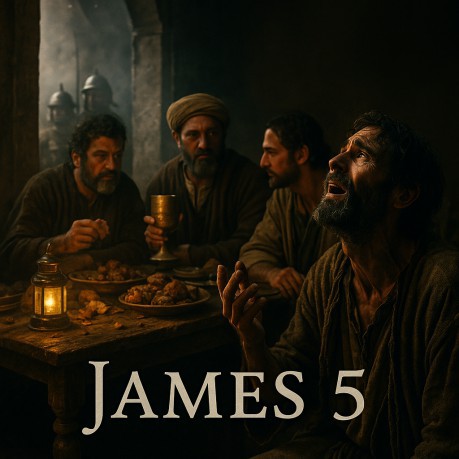
James 5 James 5:1 † James warns the wealthy oppressors of looming
judgment. Their riches could not shield them from the wrath about to
fall on Jerusalem. James 5:2-3 † Wealth and possessions, once seen as
blessings, had become witnesses against them. Their stored treasures
would not save them in the "last days." James 5:4 † Withheld wages are a sin crying out to
heaven. God hears the oppressed. James 5:5 † The wealthy lived in indulgence, unaware that
judgment was near. Their luxury only prepared them for slaughter. James 5:6 † The wealthy used courts to oppress and
condemn the innocent. James 5:7-8 † James turns from condemning the rich to
encouraging the faithful. Patience is required, for the Lord's coming
was at hand. James 5:9 † Complaints and divisions invited judgment.
The Judge was already "at the door," a phrase Jesus used in
Matthew 24:33 to show His coming was imminent. James 5:10-11 † The prophets suffered but endured, proving
God's faithfulness. Job's endurance is a pattern for believers under
trial. James 5:12 † James echoes Jesus' teaching from Matthew
5:34-37 that oaths should not be used to manipulate truth.
Simple, honest speech is enough. James 5:13-14 † James directs believers to prayer in every
circumstance: suffering, joy, or sickness. James 5:15-16 † Prayer has power not only for healing but for
forgiveness. Confession builds unity and brings spiritual health. James 5:17-18 † Elijah's example proves that fervent prayer
is effective. His prayer withheld rain for three and a half years, a
prophetic period echoed in Luke 4:25 and Revelation
11:3. James 5:19-20 † James closes by stressing restoration.
Turning a sinner back to the truth saves from death and covers sin. How it applies to us today † This is the fulfilled perspective we proclaim at
Fulfilled Prophecies † Source Index
By Dan Maines
Come now, you rich people, weep
and howl for your miseries which are coming upon you.
† Josephus (Wars 6.1.1)
describes how the rich leaders who had lived in luxury were reduced
to misery when the city fell in AD 70.
† This
echoes Luke 6:24, where Jesus said, "Woe to you
who are rich, for you are receiving your comfort in full."
Your riches have rotted and your
garments have become moth-eaten. Your gold and your silver have
corroded, and their corrosion will serve as a testimony against you
and will consume your flesh like fire. It is in the last days that
you have stored up your treasure!
†
Josephus (Wars 6.8.2) recounts how gold hidden during the siege was
discovered by Roman soldiers and brought misery to its owners.
†
Jesus warned in Matthew 6:19-20 not to store up
treasures on earth where moth and rust destroy. James applies that
warning directly.
Behold, the pay of the laborers
who mowed your fields, and which has been withheld by you, cries out
against you; and the outcry of those who did the harvesting has
reached the ears of the Lord of armies.
† This
reflects Deuteronomy 24:14-15, which commanded
Israel not to oppress hired workers but to pay them daily.
†
Josephus (Wars 2.8.2) records how the elites enriched themselves
while the poor suffered, showing the truth of James' charge.
You have lived for pleasure on the
earth and lived luxuriously; you have fattened your hearts in a day
of slaughter.
†
This imagery recalls Jeremiah 12:3, which describes
the wicked as fattened for slaughter.
†
Tacitus (Histories 5.12) condemned the luxurious lifestyles of elites
in Judea, even while their nation was collapsing.
You have condemned and put to
death the righteous person; he does not resist you.
† This reflects how
Jesus Himself was condemned unjustly, as well as His followers who
faced persecution.
† Josephus (Antiquities
20.9.2) notes how judges and leaders in Jerusalem were corrupt,
condemning the righteous.
Therefore be patient, brothers
and sisters, until the coming of the Lord. The farmer waits for the
precious produce of the soil, being patient about it, until it gets
the early and late rains. You too be patient; strengthen your hearts,
for the coming of the Lord is near.
† The early and late rains were
covenant blessings promised in Deuteronomy 11:14,
showing that the Lord would be faithful to His word.
†
Jesus had promised in Matthew 24:34 that His coming
in judgment would occur in that generation, and James echoes that
urgency.
Do not complain, brothers and
sisters, against one another, so that you may not be judged; behold,
the Judge is standing right at the door.
†
Josephus (Wars 5.10.5) describes how factions within Jerusalem
complained and turned on each other, hastening their downfall.
As an example, brothers and
sisters, of suffering and patience, take the prophets who spoke in
the name of the Lord. We count those blessed who endured. You have
heard of the endurance of Job and have seen the outcome of the Lord's
dealings, that the Lord is full of compassion and is merciful.
† The Dead Sea Scrolls (1QpHab)
reflect on the prophets as models of perseverance under persecution,
aligning with James' counsel.
† James assures
them that the Lord is merciful, even in judgment, rewarding those who
endure.
But above all, my brothers and
sisters, do not swear, either by heaven or by earth or with any other
oath; but your yes is to be yes, and your no, no, so that you do not
fall under judgment.
† Philo (On
the Special Laws 2.10) condemned unnecessary oaths, noting that truth
should stand by itself.
Is anyone among you suffering?
Then he must pray. Is anyone cheerful? He is to sing praises. Is
anyone among you sick? Then he must call for the elders of the
church, and they are to pray over him, anointing him with oil in the
name of the Lord.
†
Oil symbolized consecration and healing, rooted in Old Testament
practice (Exodus 30:25).
†
The early church fathers confirm this practice: Tertullian mentioned
anointing as part of prayer for healing.
And the prayer of faith will
restore the one who is sick, and the Lord will raise him up, and if
he has committed sins, they will be forgiven him. Therefore, confess
your sins to one another, and pray for one another so that you may be
healed. A prayer of a righteous person, when it is brought about, can
accomplish much.
†
Elijah is soon given as an example, showing how righteous prayer
brings results.
† Clement of Rome (1 Clement
56) testified that confession and prayer preserved unity in the early
church.
Elijah was a man with a nature
like ours, and he prayed earnestly that it would not rain, and it did
not rain on the earth for three years and six months. Then he prayed
again, and the sky poured rain and the earth produced its fruit.
† James encourages believers
that their prayers are powerful when aligned with God's will.
My brothers and sisters, if
anyone among you strays from the truth and someone turns him back,
let him know that the one who has turned a sinner from the error of
his way will save his soul from death and cover a multitude of sins.
†
Proverbs 10:12 says, "Love covers all offenses," which
James echoes.
† Origen later noted that the
highest work of love is restoring a wandering brother, directly in
line with James.
†
James 5 warns the arrogant rich and comforts the suffering faithful.
The destruction of Jerusalem proved that wealth and pride collapse
under God's judgment.
† Patience, prayer, and
humility remain the marks of God's people today.
†
The power of prayer, the endurance of the prophets, and the
restoration of the wandering continue to guide believers in Christ's
fulfilled kingdom.
† Josephus, Wars 2.8.2
– elites enriching themselves
† Josephus,
Wars 4.6.1 – zealots in conflict
†
Josephus, Wars 5.10.5 – factions complaining in Jerusalem
†
Josephus, Wars 6.1.1 – miseries of the rich at Jerusalem's fall
†
Josephus, Wars 6.8.2 – hidden gold uncovered by Romans
†
Josephus, Antiquities 8.13.1 – idolatry as adultery
†
Josephus, Antiquities 20.9.2 – corrupt judges condemning the
righteous
† Philo, On the Virtues 21 –
desire enslaves the soul
† Philo, On the
Virtues 38 – passions at war within
†
Philo, On the Special Laws 2.10 – unnecessary oaths condemned
†
Philo, On the Decalogue 65 – God's jealousy explained
†
Tacitus, Histories 5.12 – Judean elites living luxuriously
†
Tacitus, Annals 14.22 – sudden deaths of businessmen
†
Dead Sea Scrolls, 1QpHab – prophets as models of endurance
†
Dead Sea Scrolls, 1QS 3.6-9 – purity of hands and heart
†
Dead Sea Scrolls, 1QS 5.11-12 – deceitful prayers void before God
†
Dead Sea Scrolls, 1QH 5.35 – grace given to the humble
†
Clement of Rome, 1 Clement 34 – failure to act on truth is sin
†
Clement of Rome, 1 Clement 56 – repentance and unity through
confession
† Origen, Homilies on Jeremiah –
restoring a brother as highest love
†
Tertullian, On Baptism 7 – anointing and prayer for healing
†
Exodus 30:25 – oil of anointing for consecration
†
Deuteronomy 11:14 – early and late rains as covenant blessings
†
Deuteronomy 24:14-15 – law on paying laborers
†
Jeremiah 12:3 – wicked fattened for slaughter
†
Hosea 3:1 – unfaithfulness as adultery
†
Proverbs 10:12 – love covers offenses
†
Proverbs 27:1 – do not boast about tomorrow
†
Proverbs 3:34 – God opposes the proud
†
Psalm 24:3-4 – clean hands and pure heart
†
Luke 4:25 – Elijah's drought
† Matthew 5:4
– blessing for mourners
† Matthew 5:34-37 –
Jesus forbids swearing oaths
† Matthew
6:19-20 – treasure in heaven
† Matthew 6:33
– seek first the kingdom
† Matthew 23:12 –
humble will be exalted
† Matthew 24:33-34 –
the Judge at the door in that generation
†
Acts 18:21 – Paul says "if God wills"
†
Revelation 11:3 – three and a half years of prophetic witness
†
Hebrews 12:14 – pursue peace and holiness
Links