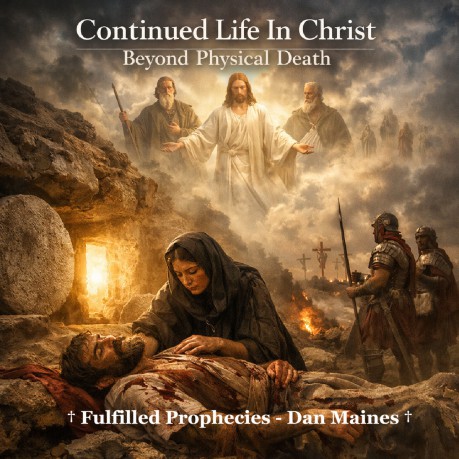
Continued Life In
Christ Beyond Physical Death Introduction † According to Scripture, a believer continues
life in Christ when he dies physically. Matthew 22:32 † Jesus said, God is not the God of the dead
but of the living (Luke 20:38). 2 Corinthians 5:8 † Paul said, to be absent from the body is to
be present with the Lord (Philippians 1:21). Philippians 1:23 † Paul also said, my desire is to depart and be
with Christ, for that is very much better (2 Corinthians 5:1). Revelation 6:9-10 † John saw souls who had been slain crying out
to God (Hebrews 12:22-24). John 11:25-26 † Jesus defines life as present union with
Himself, not as a future state triggered by death (John 5:24). 1 John 5:11-13 † Eternal life is stated as a present
possession, not a post death reward (John 3:36). † So yes, I believe that when a believer dies
physically, he continues life in Christ in a spiritual state (John
17:3). Historical References † Justin Martyr wrote that the souls of the
righteous remain alive with God and aren't extinguished by death. How It Applies To Us Today † This truth removes fear by grounding our hope
in Christ, not in survival of the body (Hebrews 2:14-15). Q & A Appendix Q Does the Bible teach soul sleep for
believers? Q Is eternal life something believers receive
only after death? Q Does physical death improve a believer's
standing with God? Q Should believers focus on what happens after
death? Q What about passages that say the dead know
nothing? Q So is this Heaven after we physically die? Q In the spiritual realm will we have eyes to
continue to see Gods beautiful creation? Q Will we still recognize those we loved in
Christ after physical death? Q Will our relationship with Christ feel more
distant or more present after physical death? Q Will worship continue in the spiritual realm? Q Will we still be ourselves, or do we lose our
identity? Q Will there be peace and rest, or waiting and
uncertainty? Q Will we be aware of God's justice and
goodness? Q Will our life with Christ end at death and
restart later? Q Will love and relationship still matter in the
spiritual realm? † This is the fulfilled perspective we proclaim at
Fulfilled Prophecies † Source Index † Matthew 22:32; 2 Corinthians 5:8; Philippians
1:23; Revelation 6:9-10; John 11:25-26; 1 John 5:11-13
By Dan Maines
†
Here's why I say that, and where Scripture actually points.
†
Scripture presents life in Christ as a present possession, not
something activated by physical death (John 11:25-26).
†
From the fulfilled perspective, eternal life begins in union with
Christ and continues uninterrupted by physical death (Colossians
3:3-4).
I am the God of Abraham, and
the God of Isaac, and the God of Jacob. He is not the God of the dead
but of the living.
† Abraham,
Isaac, and Jacob were physically dead, yet Jesus says they are living
to God (Exodus 3:6).
† This establishes that
covenant life with God isn't ended by physical death (John 5:24).
†
Life is defined by relationship to God, not by physical condition
(Romans 14:8).
we are of good courage, I
say, and prefer rather to be absent from the body and to be at home
with the Lord.
†
He doesn't describe non existence, unconsciousness, or suspension
(Luke 23:43).
† He describes continued
fellowship with Christ (Romans 8:38-39).
†
Paul's confidence rests in union with Christ, not in the preservation
of the physical body (Galatians 2:20).
But I am hard pressed from
both directions, having the desire to depart and be with Christ, for
that is very much better;
†
That only makes sense if departing the body results in continued
conscious life with Christ (1 Thessalonians 4:14).
†
Paul contrasts remaining in the flesh with departing, not life with
non life (2 Timothy 4:6-8).
† His expectation
is immediate fellowship, not delay or suspension (Luke 16:22).
When the Lamb broke the
fifth seal, I saw underneath the altar the souls of those who had
been slain because of the word of God, and because of the testimony
which they had maintained;
and they cried out with a loud voice,
saying, How long, O Lord, holy and true, will You refrain from
judging and avenging our blood on those who dwell on the earth?
† They are aware,
they speak, they recognize injustice, and they communicate with God
(Genesis 4:10).
† This confirms conscious
existence after physical death (Luke 16:23).
†
These souls are active participants in God's purposes, not absent or
asleep (Revelation 7:15).
Jesus said to her, I am the
resurrection and the life; he who believes in Me will live even if he
dies,
and everyone who lives and believes in Me will never die.
Do you believe this?
†
Physical death is acknowledged, but it doesn't interrupt life already
possessed in Christ (Colossians 3:3).
†
Resurrection life is identified with Christ Himself, not an event
separated from Him (1 Corinthians 15:45).
And the testimony is this,
that God has given us eternal life, and this life is in His Son.
He
who has the Son has the life; he who does not have the Son of God
does not have the life.
These things I have written to you who
believe in the name of the Son of God, so that you may know that you
have eternal life.
†
Life is located in Christ, not in the physical body (Galatians
2:20).
† Death doesn't grant life, it can't
remove what Christ has already given (Romans 8:10).
† That life isn't initiated by death,
it isn't earned by death, and it isn't superior to union with Christ
now (Ephesians 2:5-6).
† It's simply the
continuation of the same life already possessed in Him (1 John
5:11-13).
† At the same time, Scripture never
tells us to obsess over the mechanics of that state (Deuteronomy
29:29).
† It affirms continuity, awareness,
and fellowship, but keeps the focus on Christ as our life, not death
as our doorway (Colossians 1:27).
†
Irenaeus taught that life granted by God continues beyond physical
death in conscious existence.
† Tertullian
affirmed that the soul persists after death in awareness before
God.
† Clement of Alexandria described
believers as living unto God after departing the body.
†
Eusebius recorded the consistent early Christian understanding of
continued life after death.
† Josephus
documented the Jewish belief that the righteous live on after death
in conscious awareness.
†
It assures believers that physical death can't sever union with
Christ (Romans 8:38-39).
† It keeps our focus
on faithful living now, not speculation about the afterlife
(Philippians 1:21).
† It anchors confidence
in Christ as our life both now and beyond physical death (Colossians
3:4).
† It reinforces the fulfilled
perspective that life is realized in Christ, not postponed to the
grave (John 5:24).
A No. Scripture presents believers
as conscious and present with the Lord after physical death (2
Corinthians 5:8; Revelation 6:9-10).
A No. Eternal life is
possessed now in Christ and continues beyond physical death (John
5:24; 1 John 5:11-13).
A No. Believers are already
seated with Christ and fully alive in Him (Ephesians 2:5-6).
A Scripture directs believers to focus
on Christ as our life now, trusting Him with what follows physical
death (Colossians 3:1-4).
A Those passages describe physical
death from an earthly perspective, not the believer's life in Christ
(Ecclesiastes 9:5; John 11:25).
A
Scripture describes being present with the Lord after physical death,
not as a separate hope from Christ, but as continued fellowship with
Him (2 Corinthians 5:8; Philippians 1:23).
A
Scripture affirms awareness and perception in the spiritual state,
describing seeing, knowing, and recognizing in God's presence
(Revelation 6:9-10; 1 Corinthians 13:12).
A Scripture
indicates recognition and continued relational awareness in God's
presence, as seen in those who speak, remember, and identify one
another beyond physical death (Matthew 17:3; Luke 16:23).
A
Scripture presents being present with the Lord as deeper fellowship,
not separation, describing nearness, comfort, and communion with
Christ (2 Corinthians 5:8; Philippians 1:23).
A
Scripture portrays conscious praise and worship in God's presence,
with voices lifted and awareness of God's holiness and justice
(Revelation 7:9-10; Revelation 15:3).
A Scripture shows personal identity
retained beyond physical death, with individuals remembering,
speaking, and being known in God's presence (Luke 16:22-25;
Revelation 6:9).
A Scripture describes rest,
comfort, and assurance in God's presence, not confusion or anxiety
(Hebrews 4:9; Revelation 14:13).
A Scripture shows awareness of God's
righteous purposes, with understanding and trust expressed by those
in His presence (Revelation 6:10; Revelation 15:4).
A Scripture presents life in
Christ as continuous and unbroken, with no interruption between
present faith and continued fellowship (John 11:25-26; Romans
8:38-39).
A Scripture describes ongoing
love, communion, and shared presence with God and His people beyond
physical death (1 Corinthians 13:12-13; Hebrews 12:22-24).
© Fulfilled Prophecies - Dan
Maines.
†
Justin Martyr; Irenaeus; Tertullian; Clement of Alexandria; Eusebius;
Josephus
Links